What's derailing McLaren's season and the plan to rescue it

McLaren needs "something more fundamental" to improve its Formula 1 car's most troubling characteristics after Lando Norris said the team's sudden decline has left it a "long way off".
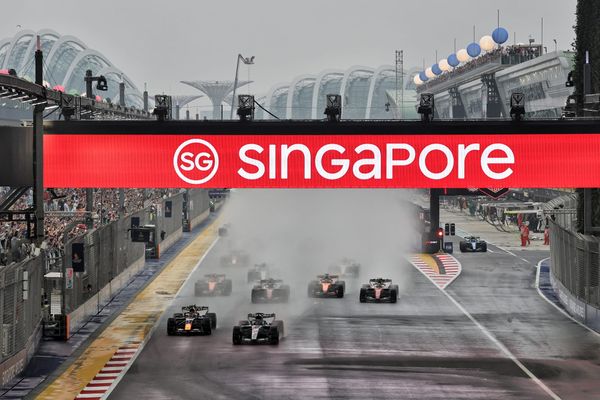
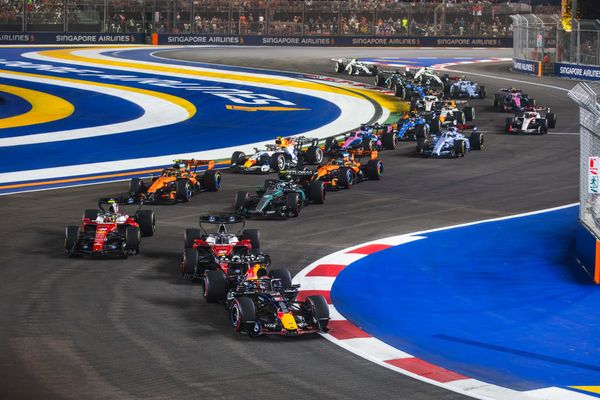
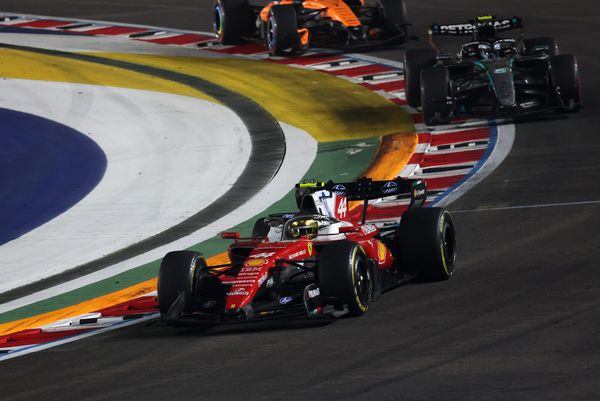
Last year's double world champion team completed an underwhelming triple-header with a distant fourth-fifth in Singapore, where Norris finished 40 seconds behind race winner Max Verstappen's Red Bull.
McLaren has fallen from scoring poles, winning races either side of the summer break, and looking a consistent threat at the front to being clearly fourth-best in just a matter of weeks.
It was catching Ferrari for second in the constructors' championship, and on certain circuits looked like it had overhauled this season's main benchmark Mercedes, but is now more at risk of being jumped by the resurgent Red Bull team for third in the standings after scoring just 33 points across the races in Azerbaijan, Malaysia and Singapore.
While circumstances played a part in this triple-header being so bad, a lack of pace was behind McLaren simply being left as the fourth-fastest team.
Part of this is explained by car characteristics and the circuits in question, because the McLaren is weaker in low speed corners, on corner entry, and on the straights. That final point is partly because its car carries more drag, but shorter gear ratios also don't help.
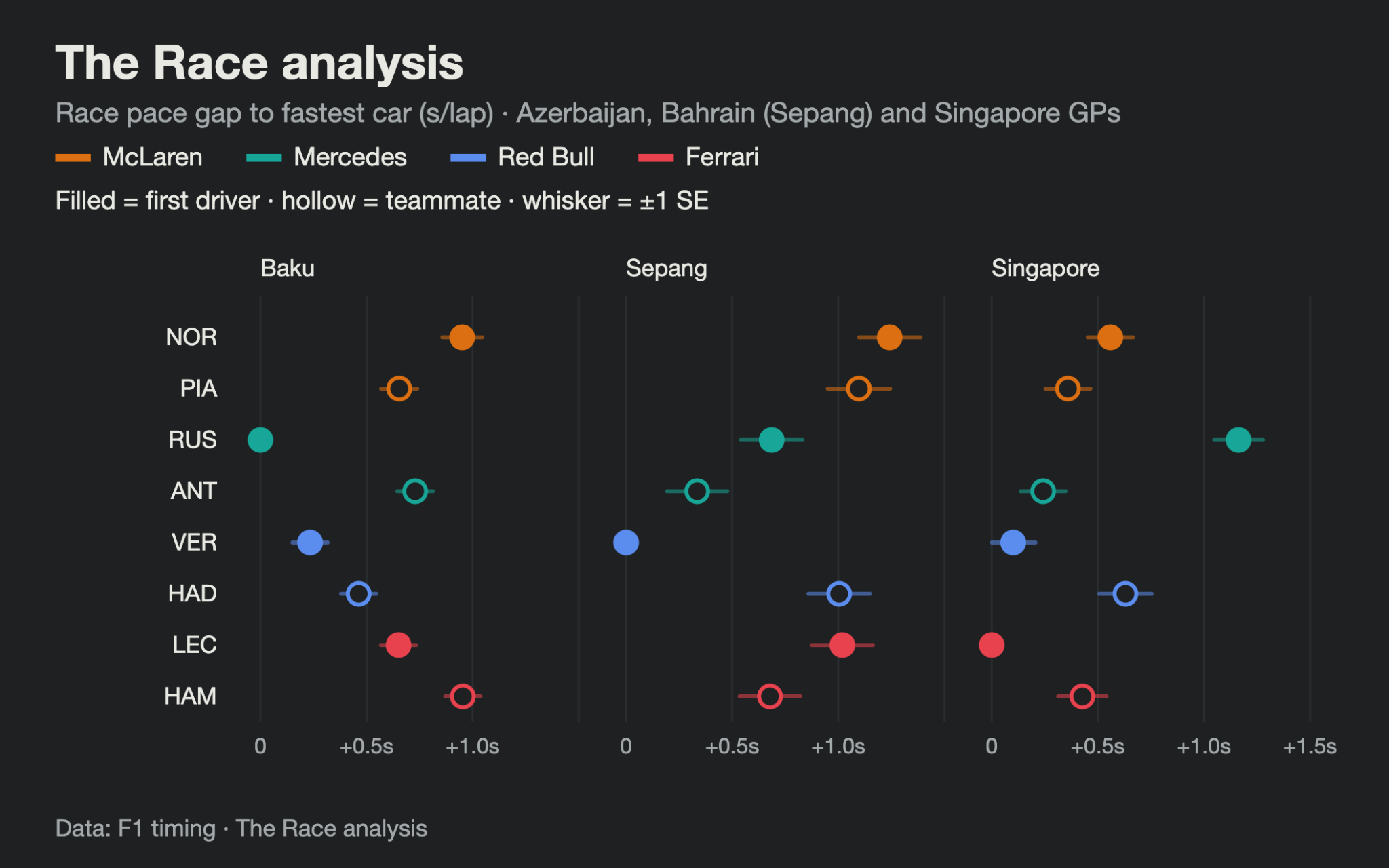
McLaren never anticipated being super strong in Baku - where it was third on the grid but a whopping 0.9s slower than engine supplier Mercedes - or even in Singapore.
Malaysia was the most confusing outlier. That has the sort of medium and high speed corners McLaren has thrived at elsewhere but it was not competitive there either.
That weekend seemed to have been derailed by the track surface roughness, which the MCL40 did not gel with at all well in terms of maximising tyre grip or even from an aerodynamic perspective.
Norris said "a lot of things stopped working from an aero point of view there", while team boss Andrea Stella talked about McLaren seeing "weird data" from that race.
So, some of this comes down to circumstances. Norris also carried a fuel systems issue that hurt his straightline speed across the Baku and Sepang events.
But even so there were factors within McLaren's control and operationally it has had a weak run, failing to maximise as a team - which includes errors from its drivers.
McLaren finished point-less in Azerbaijan, where Norris was wiped out in the multi-car restart crash caused by Franco Colapinto and Piastri went off while in podium contention.
But both drivers suffered damaging lock-ups in that race. Norris would not have been in the firing line at that restart without an error that sent him down the Turn 1 run-off and dropped him a couple of places. Piastri then made an identical mistake in the final stint and McLaren said that the car was to blame for both drivers struggling on the brakes all weekend.
In Malaysia McLaren made a bad tyre call at the start of the race which put both Piastri and Norris on recovery drives. Ferrari ended up in the same position, though: one car battling on slicks in the wet, one on intermediates but only after leaving the pits for the formation lap on slicks. The Ferraris still had the pace to finish third and fourth while McLaren was only sixth and ninth.
That result was made worse by another Norris error, this time behind the safety car, when a lapse of concentration meant he went through the Turn 1 gravel.
Then the silly clash in the Singapore sprint serves as the most dramatic example of how McLaren has let a lot slip through its fingers in a short space - almost 40 points across the three races, had it maximised what seemed possible.
The only race it really got the best result in was Singapore, where Norris was fourth and Piastri fifth. Even that was flawed - Norris made it easy for Kimi Antonelli to beat him by going off while racing Lewis Hamilton. And Piastri suffered an odd slow puncture which ironically helped him by making his final stint so much quicker on fresher tyres he was able to take advantage of Hamilton's mistaken attempted one-stop on old softs.
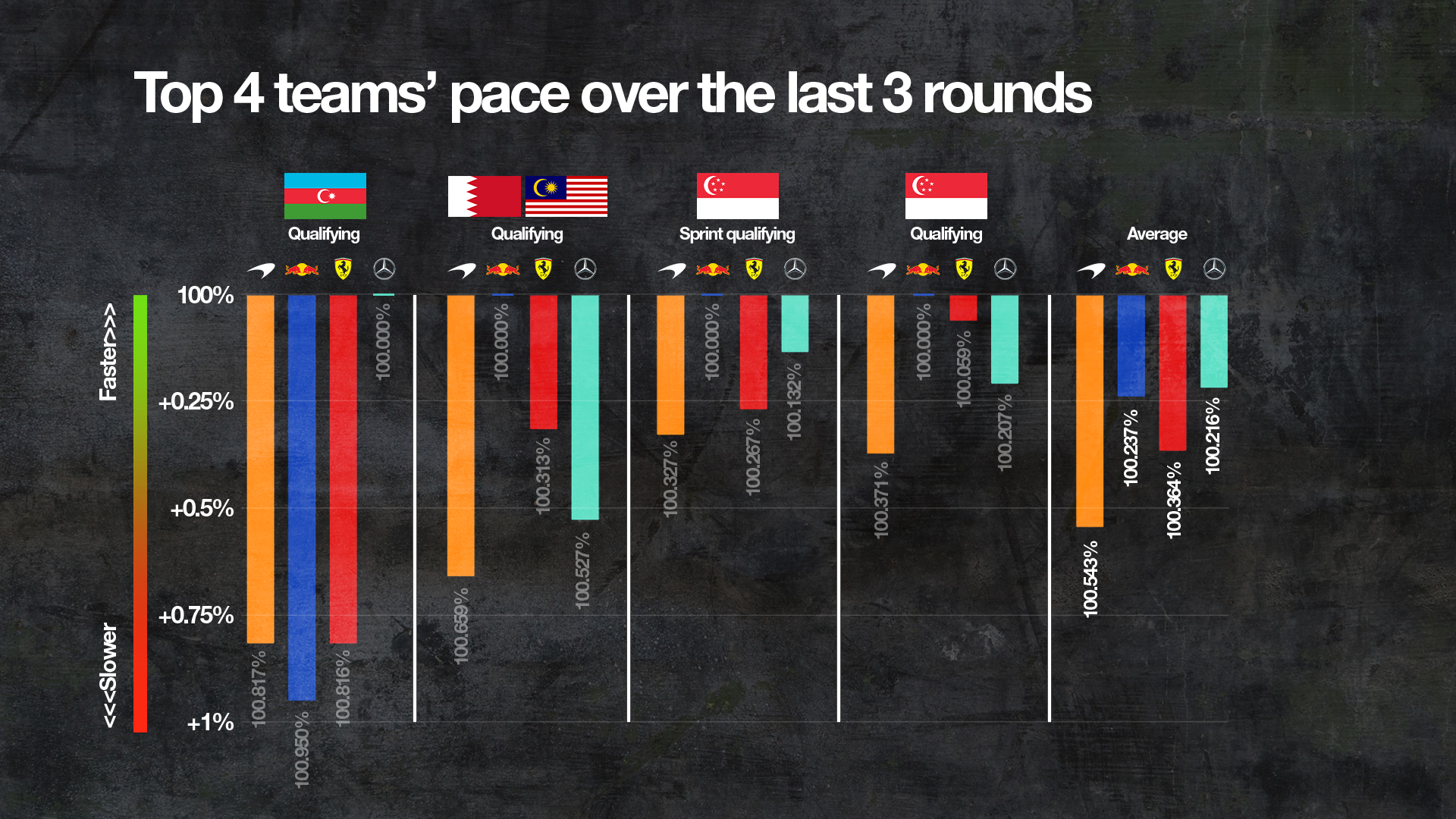
But that race pitched McLaren about right of late: sniping at one of the other teams when they were weaker, but generally off the lead pace. Its lead car was the slowest of the four lead cars in 3 of the 4 qualifying sessions (including sprint qualifying) in this triple-header. Averaged over the four, it ran at 100.54% of the fastest lap, against Mercedes 100.22%, Red Bull 100.24% and Ferrari 100.36%.
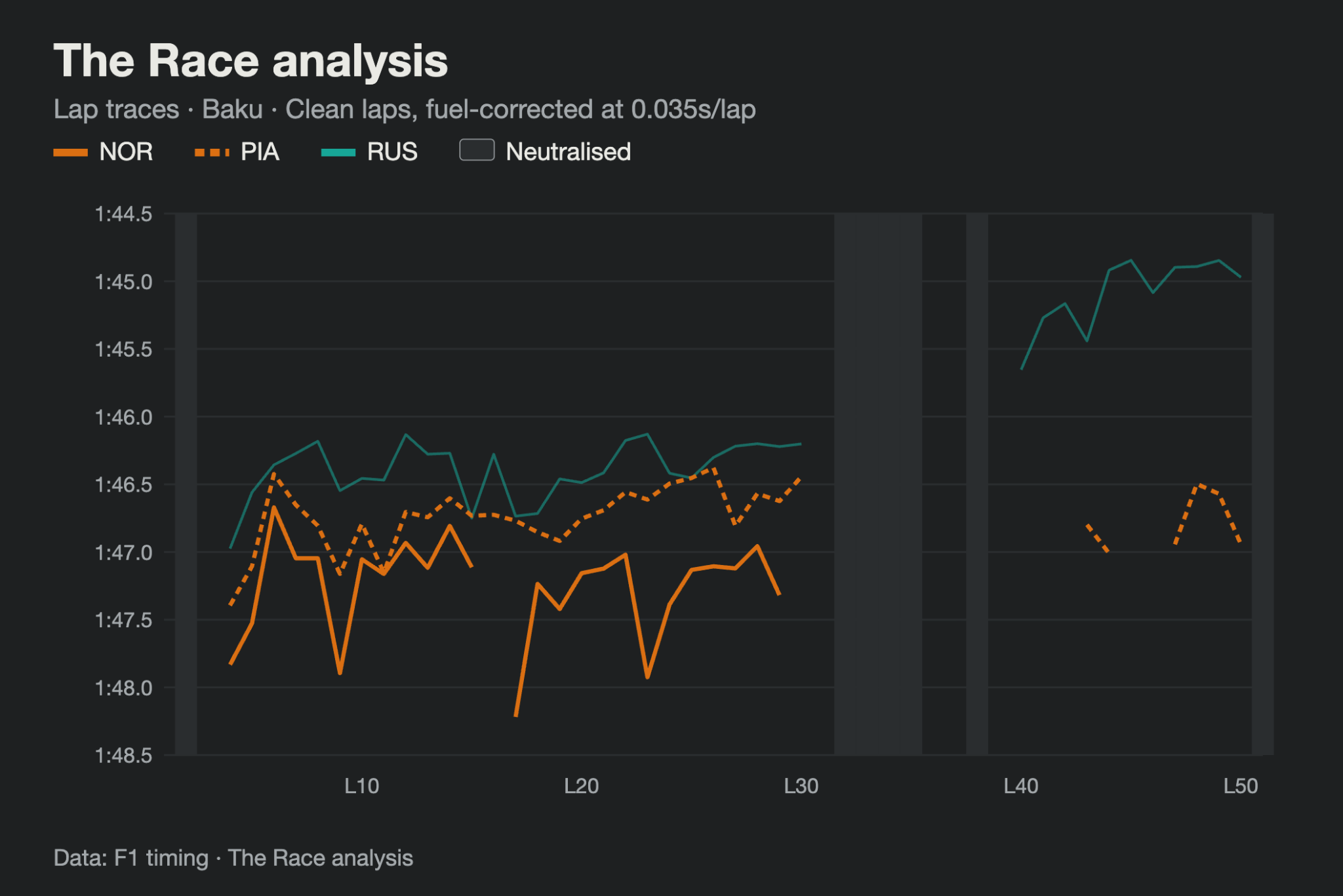
Baku was the exception: Piastri was third on the grid, ahead of both Red Bulls. But it was artificial. The pace deficit to Mercedes was enormous and Verstappen would have qualified ahead without an engine issue.
In the race, even on the softer tyre Piastri was comfortably slower than Russell's Mercedes in the long opening stint. Meanwhile Norris, like Russell on the medium, was much further off the pace.
Being such a clear slowest of the lead group at Sepang, on a circuit meant to suit the car, was particularly disappointing. Then Singapore actually ended up broadly in line with expectation - with the exception being Red Bull leading the way. It left McLaren with a 0.3s deficit in qualifying that carried into the race. The fact Norris ended up on the same strategy as Verstappen made for a direct and damning comparison as he just drifted further and further adrift.
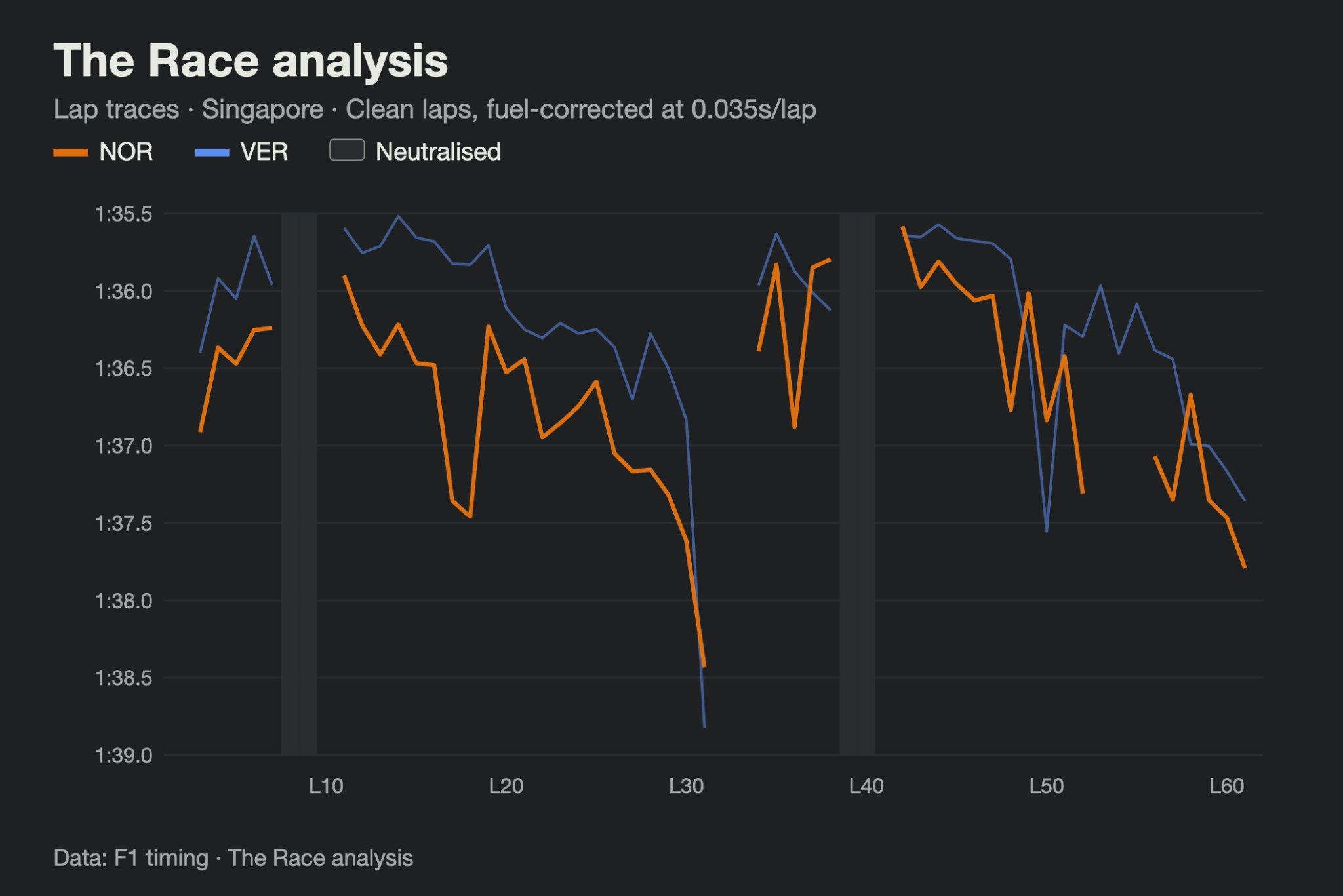
McLaren's competitiveness has partly been skewed by a bit of a shuffling of the order at the front. Stella called this the "upgrade ping pong" effect - where teams have moved around depending on when they bring upgrades.
Red Bull has made a step with its Baku update, which has unlocked more than it expected. It's added rear support to the car as intended but the gains have been exponential as it's given Verstappen even more confidence to weave his magic with a strong front end.
McLaren's own Baku upgrade package has worked, and worked as it intended, but it's not been a big enough improvement compared to the opposition. Plus in Baku its inferior straightline speed was evident vs Red Bull.
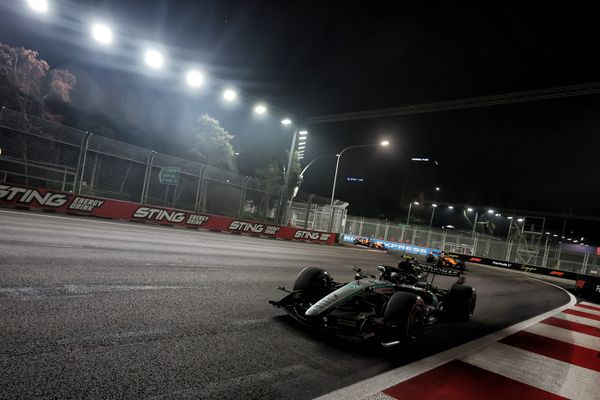
Mercedes and Ferrari are tougher comparisons. Mercedes has fallen back with an aero upgrade of its own in Malaysia that was confused by the track surface weirdness there. And while Singapore was better, the team believes it has made the car trickier to set up and drive, which meant McLaren was able to be close on pace to the team it fought for victories against just a few races ago.
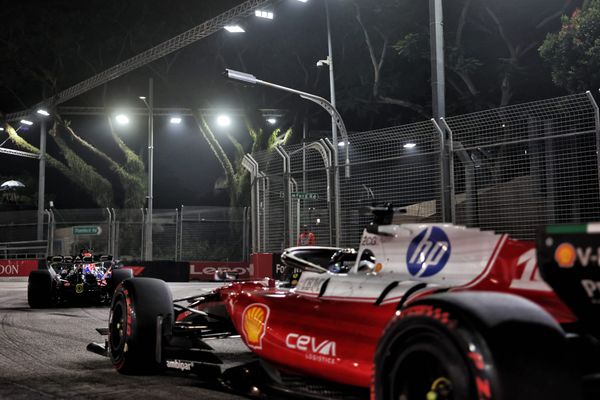
As for Ferrari, it was always going to be super strong in Singapore, as its strengths are McLaren's weaknesses: slow corners, but also in Singapore at medium-speed.
Ultimately, Norris says the McLaren is "too difficult to drive" and that even if it feels like there's more potential in it, it's too unpredictable.
"It's just on a knife edge on every single corner," he said.
"You've got to drive it within that exact percent and you have to force the car in every single way, you can't let the car do any work. You have to force the front, you've got to force the rear.
"You've got to drive it in a way that takes so much concentration and so much ability. It's just full-on and mentally draining because of how hard you have to work behind the wheel.
"It's just too difficult and it makes it impossible to put laps together in qualifying."
This chimes with what Piastri and Stella have talked about recently that their car seems to haemorrhage laptime if it's driven even slightly under the limit. So it does seem to be asking an unusual amount of its drivers – which maybe hints at McLaren developing its car into a very peaky window either aerodynamically, mechanically or both.
When it all lines up, and the circuit demands are kind enough, there's mega pace to unlock. But even then it's still a handful - neither driver says they are comfortable or happy in the car even when it's quick.
There are still some final improvements coming in 2026 and McLaren hopes that a sizeable aero package for the US Grand Prix at Austin could eat into most of what was a representative 0.3s deficit in Singapore.
But Stella says the broader, nastier car characteristics can't be solved just by adding downforce which is what the remaining 2026 work will prioritise.
"We need something more fundamental than simply adding some downforce to the car," he said, "like is happening in the coming races without fundamentally changing some further aspect – which we are addressing longer term and at the earliest, I would say with the MCL41 for 2027."
This development will still be important, not just for what McLaren is fighting for in the championship but because some of the fundamental car concepts will be carried into 2027.
"We do plan to deliver some upgrades, we hope that they will be able to fill this gap that we have to the best cars and put McLaren in condition to fight for podiums on merit," he said.
"And then whether we can fight for the victory, this I think we will have to see probably the last three races, because the upgrades will be delivered in phases.
"It's important for us that we deliver upgrades because we are in a close fight for a championship position, but we also want to prove some of the fundamental concepts that we'll carry into next year's car.
"Because at this level of maturity of the cars you're starting to push the aerodynamic development and you may start to see that things work, but some things may not work because aerodynamics is starting to get complicated enough after what it's basically two years of development.
"If we consider that the development started the 2nd of January 2025 and now we are well into 2026, so after two years now it's complex, it may go right, it may go wrong.
"So we wanted to track test some of the fundamentals we carry into next year."