

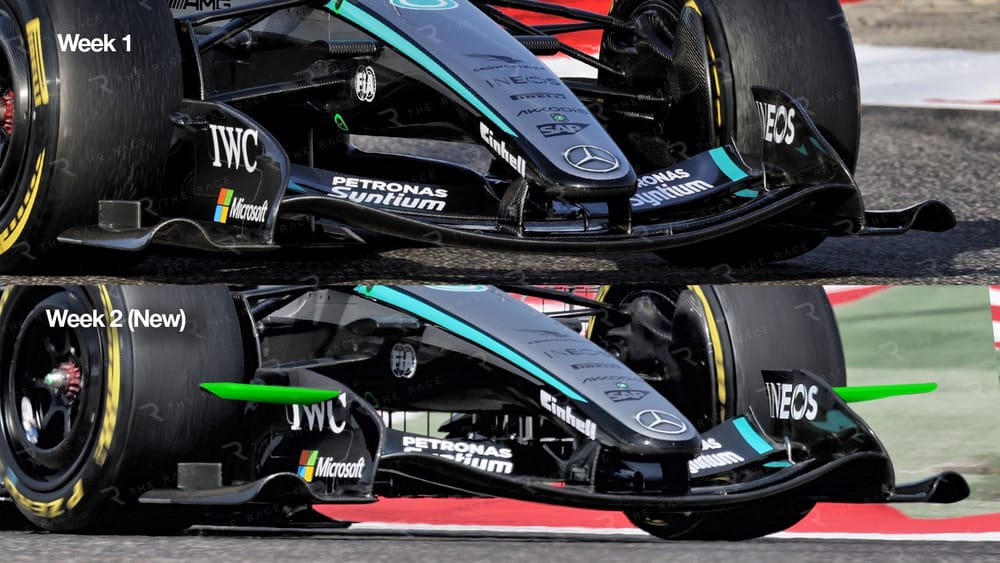
Mercedes has arrived at this second Bahrain 2026 Formula 1 test with quite a few updates or, depending on how you look at it, additions.
The team ended the last test first and second on the timesheet, so it's obviously not afraid to show its hand in public before Melbourne, and it has further updates to shakedown here.
From front to back, we have the following on the altered W17.
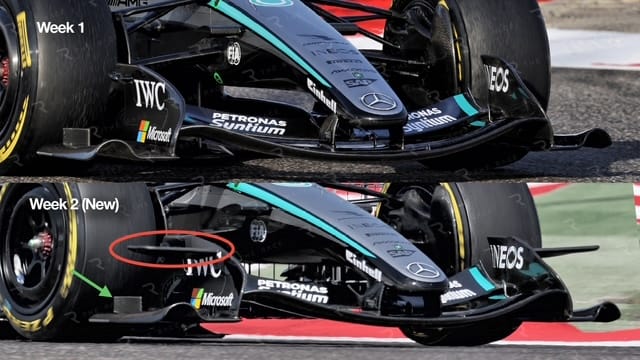
Mercedes has now added that horizontal vane (red ellipse) to the outer surface of the front wing endplate. That splitter will do exactly what it says on the box: split the airflow that is arriving at the tyre, and as opposed to it getting pulled over the top of the tyre, that lower flow will be directed downwards and around the wheel. It has retained the small vane (green arrow), which is there to generate outwash.
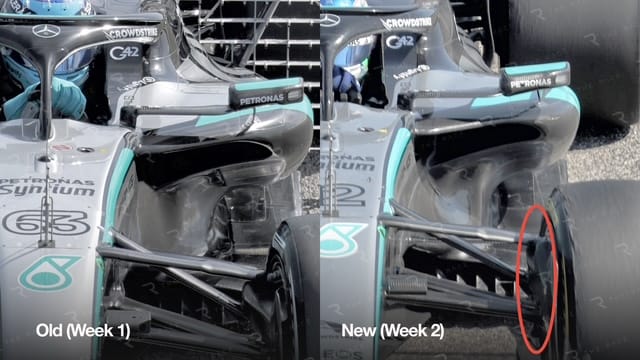
The team has also reduced the bulk of the front brake duct (red ellipse). The larger the opening between the inside of the front wheel assembly and the side of the chassis, the less effect it will have on the performance of the airflow coming off the front wing. Also, the greater the volume of airflow that can get through between the inside of the front wheel assembly and the side of the chassis, plus what can get through the opening below the chassis, is what the rest of the underfloor has to work with. So the more airflow, the better.
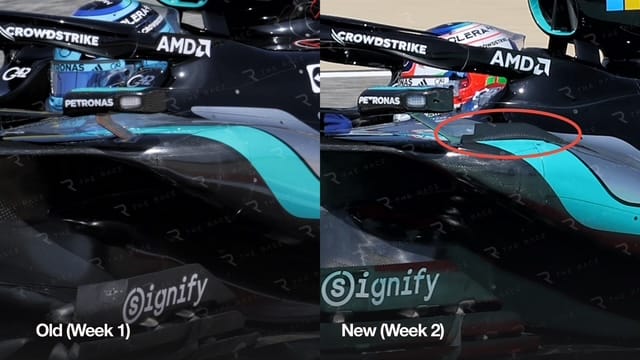
A small airflow directional vane (red ellipse) has also been added to the upper surface of the sidepod. It is just behind the rear-view mirror vertical stay; this will work in conjunction with what Mercedes has also done with the cooling exits below.
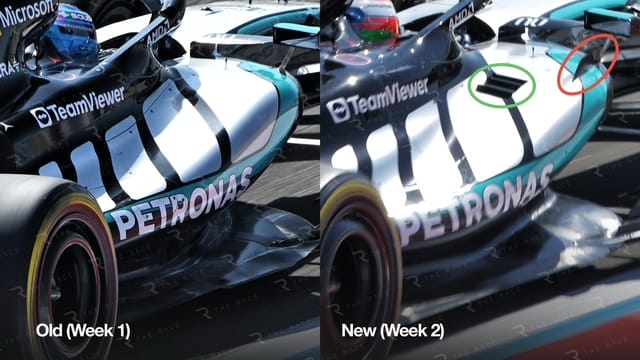
This picture shows that airflow turning vane (red ellipse), but also the addition of a small hot air radiator exit. The vane will direct the mass airflow and that airflow will improve the exit airflow from the internal radiator system.
It may be that with the radiator layout it has, Mercedes had a small stagnation problem in that area so opening up an exit has simply improved the overall cooling by making full use of the radiator area.
The picture below shows that exit (green ellipse) on the other side. To me it looks a little larger than on the driver's right hand side. Normally the radiator layout is asymmetric, so perhaps Mercedes was having more of a problem with what it was cooling on the driver’s left-hand side versus the right-hand side.
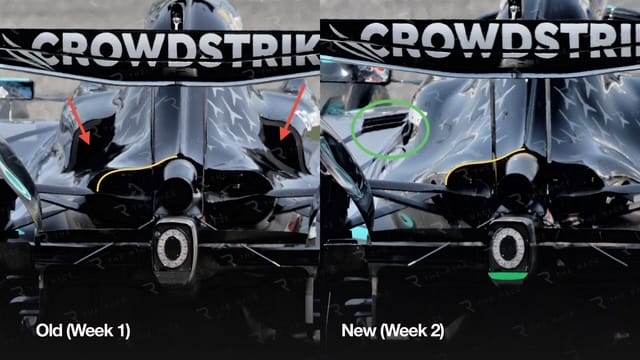
It also shows that Mercedes has removed the exits (red arrows) on the sides of the engine cover and even reduced the size of the rear exit (yellow line). I have moved the yellow line, which is positioned on the edge of the new engine cover exit, across to the older version and I believe it’s a little narrower.
Cooling exits are the thing we see the teams change from circuit to circuit. They are dependent on circuit characteristics and ambient temperature. From what I am seeing, it looks like the heat rejection from the Mercedes power unit is well under control, as it’s by no means cold in Bahrain.
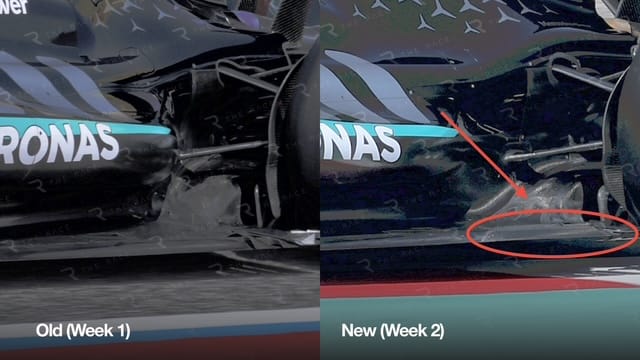
It has also altered the flow detail on the floor just in front of the rear tyre. Mercedes has gone from inlet louvres to connect the airflow that is on top of the floor to what is called the tyre squirt, which the teams are trying to get to go around the outside of the tyre contact patch, to what looks like a turning vane (red ellipse). It looks like it goes inwards, but I would need to see more of it to try to understand its influence on the airflow.
The area highlighted with the red arrow looks like it has been modified, perhaps to go with what that vane has done to the airflow.
