

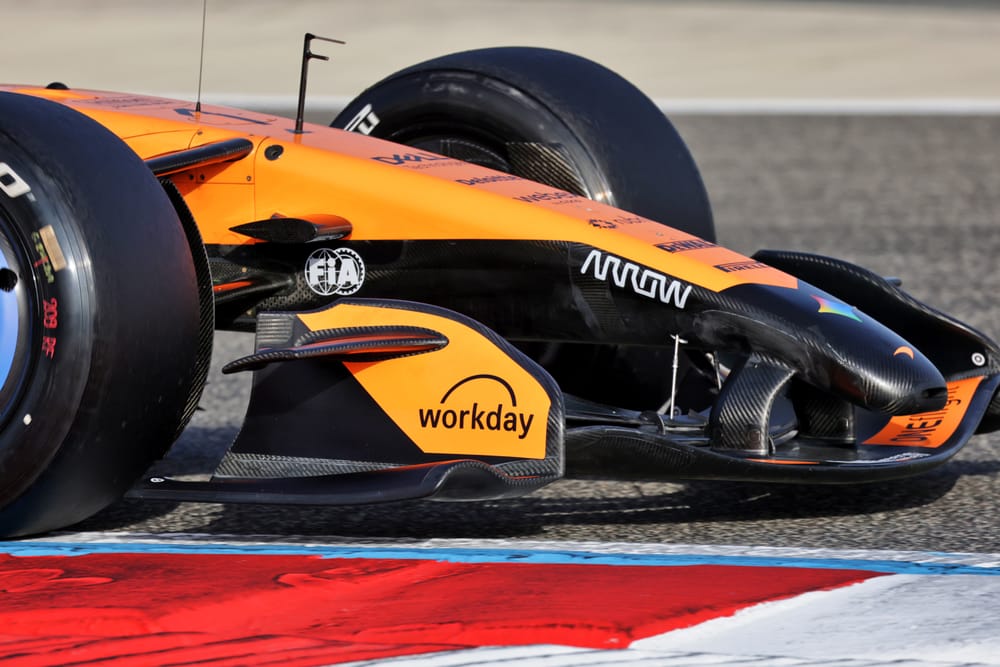
Whether as a technical director or in my current role, I always enjoy sifting through endless detailed photos of Formula 1 cars to see how teams have exploited the design opportunities in various areas. That same process will be going on in every team up and down the pitlane, as it can inspire new development directions.
There's no right or wrong, but there are always other ways of achieving the same, or perhaps a slightly better, end result. Here's what stood out to me.
Front wing endplates
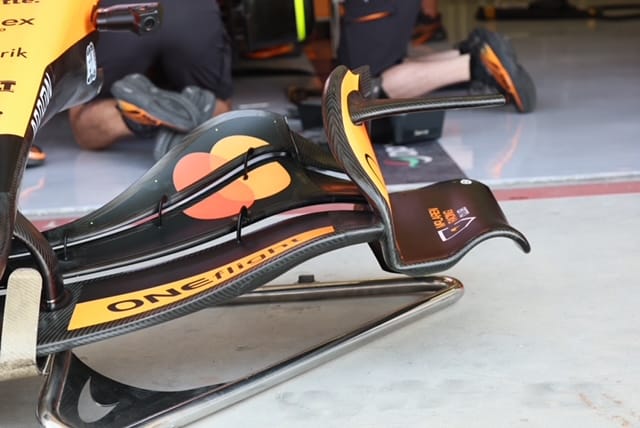
Starting at the front of the car, the front-wing endplates have changed dramatically this year and there's a range of different approaches.
McLaren's are fairly three-dimensional upwards of where the wing elements mount. This curved profile and the horizontal downward curved splitter work in conjunction with that curved section and the dramatic drop-off of the flap angles at the outer end to create as much down and outwash as possible. Connecting this airflow to the outward tyre squirt makes the outwash system very powerful.
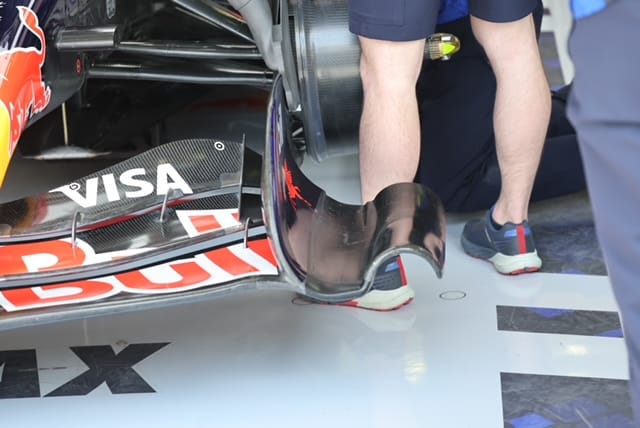
Red Bull has gone for the super-curvy shape. It has a fairly simple endplate from the wing elements upwards, with no horizontal-style splitter, but very curved from those elements downwards. This lower curvature will reduce the sensitivity of the foot of the endplate relative to the track surface.
Although these cars don't move very much vertically or in roll, it is still important to have a consistent balance during braking and through the corner. Also, that increased opening at the end of that curvature and the drop-off of the outer flaps will induce outwash and connect that airflow to the tyre squirt.
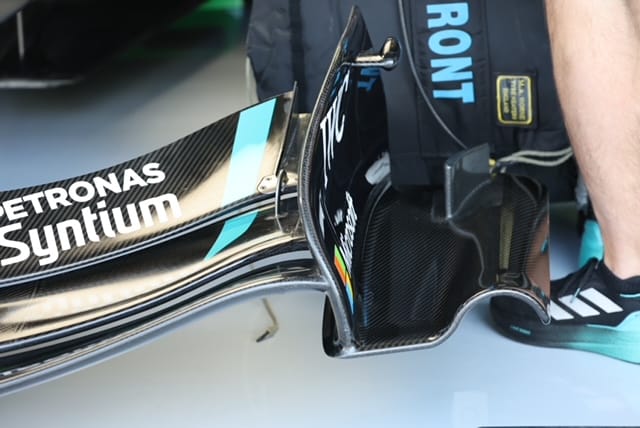
Mercedes has gone for the three-dimensional version, although not to the same extent as McLaren. There's no horizontal upper vane, but it has a small vertical vane on the trailing edge of the footplate. Taking the opposite approach to Red Bull, Mercedes has extended that footplate inwards to increase the surface that gets close to the ground.
It has also dropped off the outer section of the rear flap. This means the endplate curvature goes outwards as it moves rearwards. With that small, vertical turning vane and the dropped off angle of the rear flap, it will also be inducing outwash.
Bargeboards
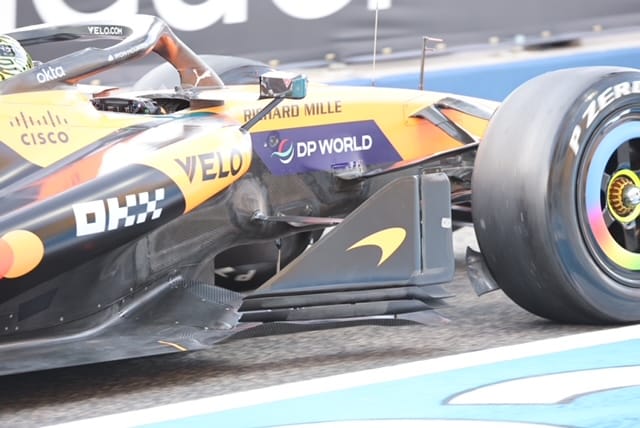
The bargeboards, which under these rules are called floorboards to ensure that fans are as confused as possible, are defined by the regulations to encourage inwash. To achieve this, the angle gets wider going forward with the intention that they would pick up the front tyre turbulent wake and, to use a word Adrian Reynard once taught me, 'scoop' up that turbulent airflow and direct it into the sidepod undercut. But as expected, the teams have found other solutions.
McLaren has gone for vertical-style bargeboards. With the main turbulence being around the centre of the rear tyre, the vertical section and its slot gap will tidy up some of that disturbance. It also has some small horizontal vanes to help scoop (that word again) up the inner tyre squirt as it tries to fill up the void where the tyre is coming away from the track surface.
You can also just see the end of the vane that is mounted on the inner surface of the front brake duct, which is also to connect up the inner tyre squirt as it goes around the tyre's contact patch with the track surface.
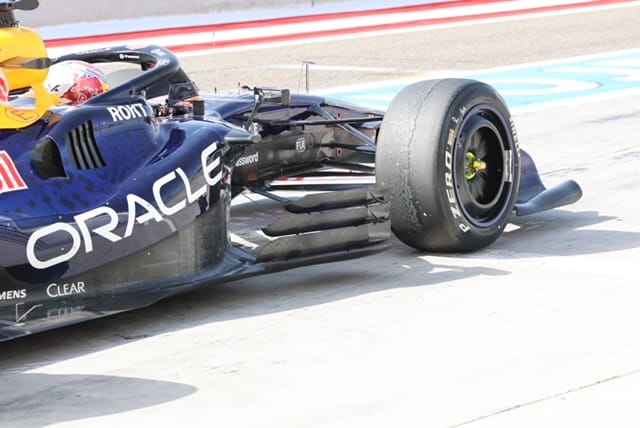
Red Bull has gone with a more brutal horizontal vane bargeboard assembly. It is more focused on managing the airflow that is coming around the inside of the front tyre and, in simple terms, getting it out of the way of the sidepod front corner undercut.
You can also just see some very small upward turning vanes on the forward area of these horizontal vanes. These will be to connect up the outer tyre squirt to the airflow that is coming through those horizontal vane slot gaps trying to unite the airflow that is going around the tyre.
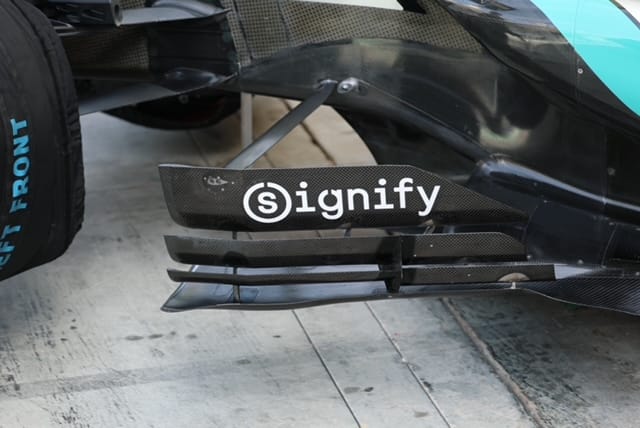
Mercedes is similar, but not as brutal as what we see on the Red Bull. It's all about minimising how much of that tyre squirt you let get pulled under the leading edge of the floor.
Front of floor
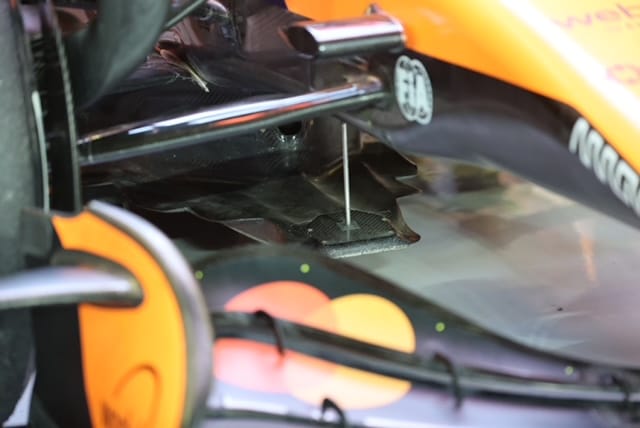
The leading edge of the central section of the underfloor is an interesting area. This is the area where we will see the sparks coming from under braking this year. With the cornering mode versus the straightline mode, the compromise on front ride height is going to be critical to overall performance.
When you are in straightline mode, the downforce front and rear will be reduced fairly dramatically. But just as you hit the brakes, you will instantaneously get the actual downforce relevant to the speed you are traveling at. That will lower the front ride height significantly.
The percentage of anti-dive, which looks in general like most teams have increased for this year, will react to some of that weight transfer from braking, but not the actual vertical movement due to that increased vertical aerodynamic load.
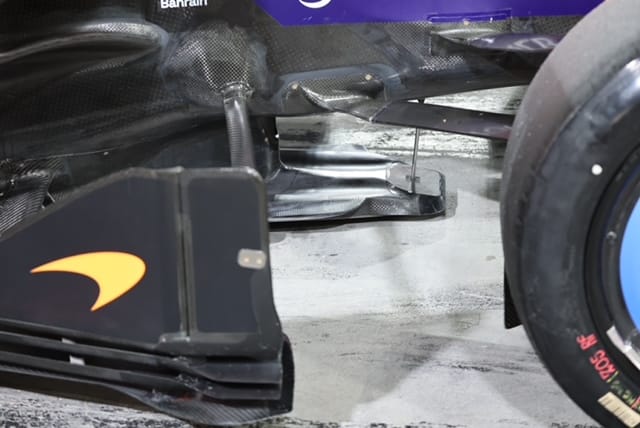
McLaren has gone to town on this area this year to try to compensate for that vertical front movement when the driver hits the brakes. It has small ramps on each side of the front skid plate section.
These ramps will reduce its sensitivity to the track surface and will also form a sort of air cushion between that part of the floor and the track surface and probably allow it to run a slightly lower average front ride height without the car beating itself into the ground under initial braking.
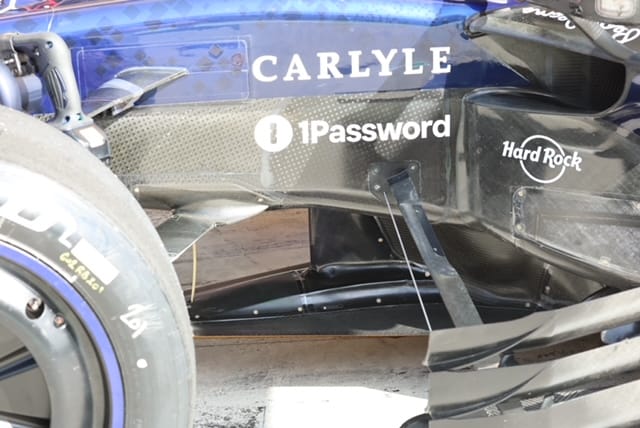
Red Bull has gone for a more normal wedge-shaped front floor section. It is minimised in depth outboard, but still has thickness inboard on the centreline. This thickness is to cover the mechanical mechanism that is inside this section of the floor.
Inside, there is a mechanism similar to a motorcycle rear swingarm. The horizontal arm pivots at its rear on the front of the chassis. It has the front skid mounted at the front of it and somewhere along its length it has a vertical spring and damper set-up between it and the chassis, that spring has to be preloaded to a certain rate which is defined in the regulations.
This allows the front section of the floor to deflect upwards if the driver goes over a kerb, but theoretically not deflect from the car simply hitting the track surface when driving on the normal racing line.
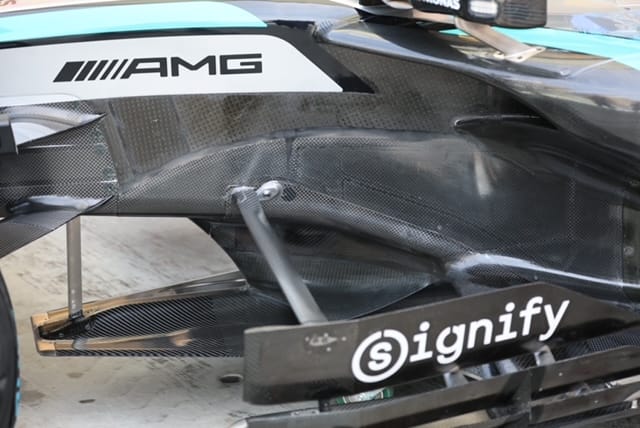
Mercedes again is very similar to the Red Bull in that area. All three, as will all the other teams, have a similar swing arm mechanism.
All these are bolt-on goodies, so we will see whose design and development paths are followed by rivals as updates get bolted onto these new cars, which are still very much in their infancy.
