

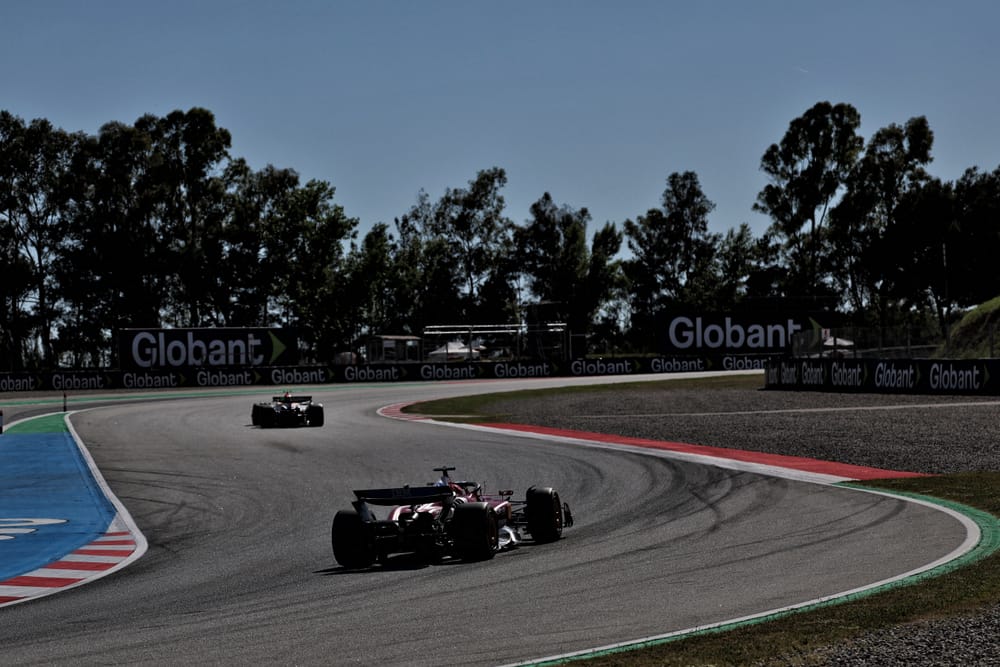
The first Formula 1 pre-season test is not only being held in private, but also allows the 11 teams to select which three days they run on out of the five scheduled for Barcelona on January 26-30. The question is, how would that test best be used?
Ideally, you would have carried out a shakedown test - or as it’s now called a filming day, with maximum running limited to 200km - either before the Barcelona test kicks off or on the first day of the actual test.
If you use the first day of testing as effectively the shakedown, then that will delay you getting into the work that those teams who have already completed their shakedown should be able to dive straight into.
This shakedown will be mainly to check the car systems. Cooling systems these days are fairly intricate; you have engine, hydraulic and gearbox oils, the main water cooling system, you also have the plenum charge, battery pack, energy management system and the MGU-K all to keep under control temperature-wise.
Some of that cooling will be done with direct cooling, air to the relevant fluid, others with intercoolers, fluid to fluid, but the car systems added together have a level of overall heat rejection that the car passing through the air has to stabilise. Remember, these cars don’t have cooling fans.
So for initial testing, the car would have extra flow, pressure and temperature sensors mounted in the pipework to make sure it's all working as planned. Unless there are any problems discovered, it would only take a couple of five-lap runs to do a basic check.
One other thing to remember is that airflow used to cool the car is being wasted as far as creating downforce is concerned. When it’s passing through the various radiator cores and increasing in temperature for cooling, all of the energy of that high-speed airflow is used up, so to have the best overall car performance, everything is always on the borderline.
If you have a car that’s not at that limit on cooling, then by definition, you are giving away performance.
As for the brake cooling, this has probably the most influence on the overall airflow structure around the car. The front brake ducts are always on the move with varying steering angles because of different corner profiles on a circuit, so to cope with that, they need to have a reasonably wide working window. The rear is more stable, but still critical to the performance of the underfloor and diffuser.
The regulations in this area have changed for 2026, so it’s a fresh learning curve for the teams. Last year, McLaren started the season more in control of cooling than its rivals, affording it an initial advantage, but the others soon closed the gap. It will be interesting to see who has learned the most in this area for 2026.
If problems do arise, then the team back at base will look at them and try to pinpoint why. If you see a car stuck in the garage after those first couple of runs, it could be more about diagnosis than changing a part. This is why it’s better to commit to a 200km filming day, as opposed to losing a complete test day of running.
This allows you to go to the test not only having worked through those shakedown items on the run-plan, but also to do all the number crunching and analysis you want before testing really gets going.
How you use the three days of running across the five available all depends on when updates and or development parts are scheduled to arrive. I’m pretty sure the airways between England/Italy/Switzerland and Barcelona will be pretty busy next week.
I doubt many teams will carry out much chassis development during this initial test. It will be more about making sure the power unit and the systems are working as planned and that the PU is reliable.
The priority is being able to switch it on in the morning and switch it off at night and be confident it will be running whenever you need it in between. It’s the old saying, ‘to finish first, first you have to finish’.
As for the chassis, it will be about making sure that what you have at the tests correlates on track with your predictions. This means checking downforce levels, balance changes with differing wing levels both front and rear, varying ride heights, and the more difficult one, which is the aerodynamic centre of pressure shift due to steering angle, roll and yaw. This can make or break a car’s overall performance.
You must also give both drivers a decent amount of time in the car, so it’s all about sharing out the run time. That’s not so difficult if you have genuine number one and two drivers, but more difficult if you have two equal drivers.
Over the years, we have seen teams that change the driver at lunch time, while others do a full day. Neither is automatically correct and you need to monitor the mileage each driver gets and adjust to suit as problems crop up and run time gets diluted.
As far as monitoring what the others are up to, we often hear that each team is just going through their own programme and not paying attention to rivals. That’s rubbish. With any set of new regulations, each team can only do what they can do, but their relative position is down to how good a job the others have done, so you need to keep an eye open to see where you stand.
I’m not just talking about one quick lap on the timing screen, I’m talking more about the level of ease and consistency that they can produce those laptimes and how many laps they can run without problems. Putting in one quick lap and then having a problem is very different from 10 consecutive laps, all getting faster as the fuel burns down.
Having a couple of engineers with good eyesight out on the track looking at your own car and comparing it to the others never goes amiss. This is the part I used to enjoy, and on many occasions the driver would be saying one thing but you could be seeing something different and pick up the handling problems relating to it.
The driver adapts very quickly to what he is driving. As an example, when the rear is a little nervous on entry, they will turn in slightly early, leading to mid-corner understeer and a snappy rear on exit. This is what the driver will be complaining about, when the real problem is a nervous rear on corner entry. Identifying the root cause of such problems is therefore essential.
As for car performance, you are always working on that. You want to get the best out of what you have, so you will go through a planned list of set-up changes: front and rear toe and camber optimisation, front and rear ride heights, stiffer versus softer front vertical stiffness, stiffer versus softer rear vertical stiffness, then the same for the front and rear central spring rate, and when it comes into play, front and rear roll rate, front and rear damper characteristics etc.
It’s not that you are trying to get the ultimate performance setup from the package, it’s more about logging the changes that are variable and putting them into your databank for when you need them. It’s also important for the driver to be able to feel the changes and give the engineers feedback. Getting that to correlate with the logged data that is gathered is critical to how you attack a race weekend.
Reliability problems can interfere with the overall programme, but most teams have a lot of experience with this, so the plan will have gaps to allow in-depth data analysis and allow the mechanics to have a good snoop around the car. Remember, these cars are new, so they will need inspection time. The last thing you need is a failure that wipes out the complete test.
Also the weather. It doesn’t happen often in Barcelona, but I have been there when it has snowed. Rain can have a major influence, but in reality, anything the weather can throw at you is the same for everyone, as opposed to you suffering your own individual reliability problems.
Bad weather early in the test could also influence how you allocate your three days of running. If your plan is to run on day one and the track is damp or in a bad condition, then you have to make changes to your plans.
Remember that F1 cars, particularly at the start of a new set of rules, are also always changing. I’m pretty sure these new cars will be getting performance updates right until they leave the pits for the first lap in qualifying in Melbourne.
What could've gone wrong for Williams
One team that won't be doing anything at Barcelona is Williams, which has announced it's missing the test. As the team hasn't said exactly what the problem is, my perspective as an ex-F1 technical director would lead me to the following potential reasons:
1) The car package might simply be overweight and needs to go on a diet. But if so, Williams should still be able to run at Barcelona to accumulate data and get system checks out of the way. Even if limited to two days or even one, that's much better than not running.
2) Something major from the jigsaw that makes up a current F1 car is missing. Obviously, this comes down to hour-to-hour communication between the build schedule and component manufacturing schedule. This is what was blamed a few years ago, but Williams is much improved in terms of these capabilities now.
3) Something has not passed the FIA crash or impact tests and the car isn’t ready to run on a racetrack. Again, that is an organisational problem that follows from not having enough recovery time built into the schedule. If you are pushing the limits, you need to allow recovery time.
4) Something that the FIA has seen or that Williams has requested clarification on doesn’t satisfy the regulatory requirements.
In reality, it doesn’t matter what has caused this problem as long as Williams learns from it. Yes, the loss of that initial test time will hurt but as long as Williams is in Bahrain and first out of the pitlane on day one of testing, it can recover.
If not, then Williams will have thrown away everything it thought it was planning for by starting early on the 2026 package.
