Six things Honda's revealed about 2026 F1 engine
Honda's main concern for its 2026 Formula 1 engine is the V6 as it expects this to be the primary differentiator and its previous combustion engine approach is "largely unusable" for the new rules.
Testing begins next week at Barcelona which will give Honda and new partner Aston Martin their first on-track experience together.
Honda Racing Corporation president Koji Watanabe said there is a "reasonable degree of confidence" that Honda can hit its targeted performance levels constantly and "there is a mixture of anticipation and uncertainty" ahead of the first on-track running of the year.
In a detailed Q&A released by Honda, several key technical challenges for the new rules - and how Honda views them - have been addressed.
Key Honda approach 'largely unusable'
The new engines strip away the MGU-H that was part of the 2014-25 power units, recovering thermal energy, and massively increase the output of the MGU-K, the kinetic energy recovery system.
This makes the engine almost 50/50 between the internal combustion engine (ICE) and electric power, and has rendered previous Honda techniques obsolete.
However, despite the increased focus on electrification, it's clear that Honda's own focus and concern is on maximising the V6.
Tetsushi Kakuda, Honda's F1 technical lead, said "the ICE is where differences are most likely to emerge".
"How much output you can extract from the ICE, and how you achieve high performance together with the new fuel, is extremely important," he said.
Before Honda's planned withdrawal from F1 (which never really happened) the manufacturer fast-tracked a brand new engine design for the 2021 season, which was then homologated and used until the end of 2025.
That included redesigning the turbine and compressor, offsetting the cylinder banking, altering the combustion chamber to produce more power while making the engine shorter, lowering its centre of gravity, and shrinking it overall to a size smaller than its ill-fated size-zero McLaren concept from 2015.
This achieved a Mercedes-beating engine and made Honda the benchmark over the last few years - but it is all irrelevant for 2026 onwards.
"From our perspective, the high-speed combustion approach that delivered results with the previous PU [power unit] is now largely unusable due to compression ratio limits and changes in fuel flow. That means we have to find new ideas to improve performance. Other manufacturers are in the same situation, so it really becomes a competition of ideas."
'Complete reset' of engine
However, the scale of the whole change is significant. Watanabe inadvertently caused a huge amount of scrutiny a year ago when he said Honda was struggling with the new rules - which was more a case of misspeaking while trying to convey how hard the development process is, than admitting Honda was in trouble.
Kakuda said that "everything" is difficult because the overall engine is "essentially a complete reset" beyond the basic architecture of it being a V6, turbocharged engine.
"The internals are completely different: the combustion system and the fuel have changed, so the requirements are entirely new," he said. "In that sense, it really is a new engine.
"With the elimination of the MGU-H, we have to rethink how we use the turbocharger.
"The compression ratio is more restricted, variable intake systems are no longer allowed, and deciding what kind of engine to build has become a completely new challenge.
"On the electrical side, output increases significantly, and the amount of energy flowing in and out of the battery and the control electronics becomes enormous to match the motor.
"In short, this is a power unit that requires entirely new development across the board."
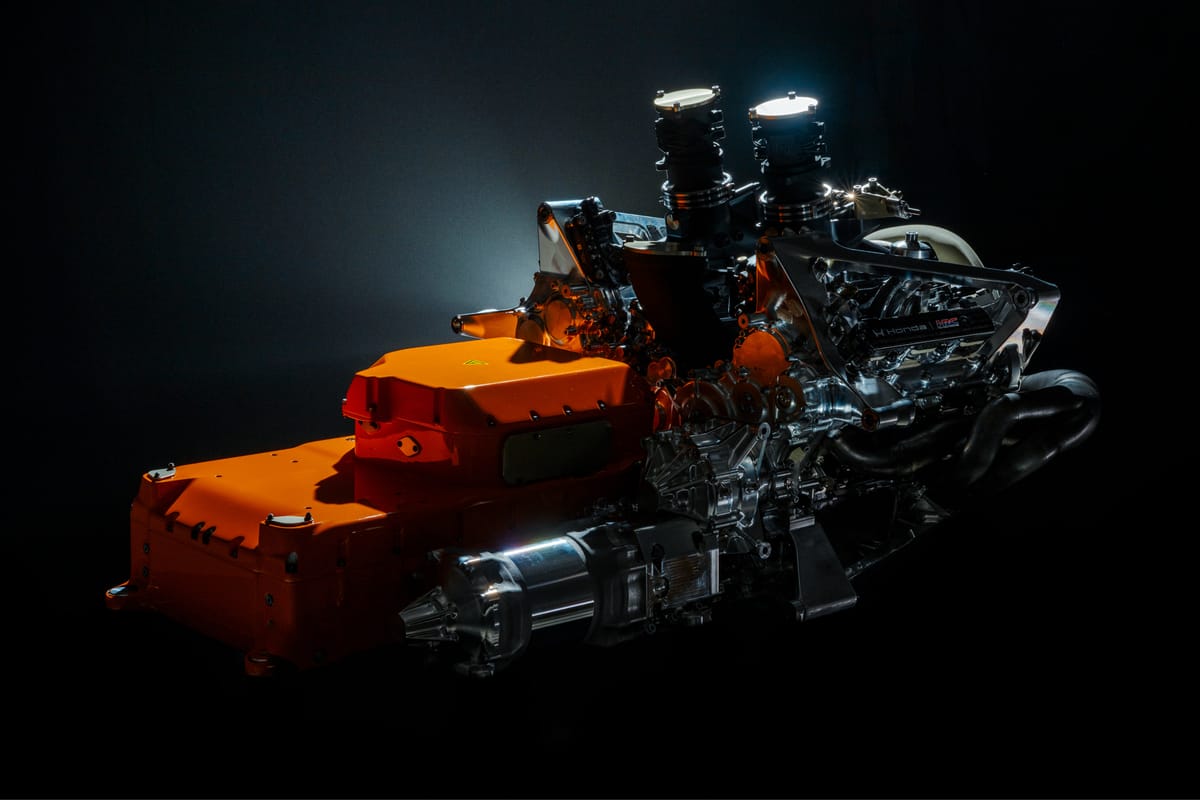
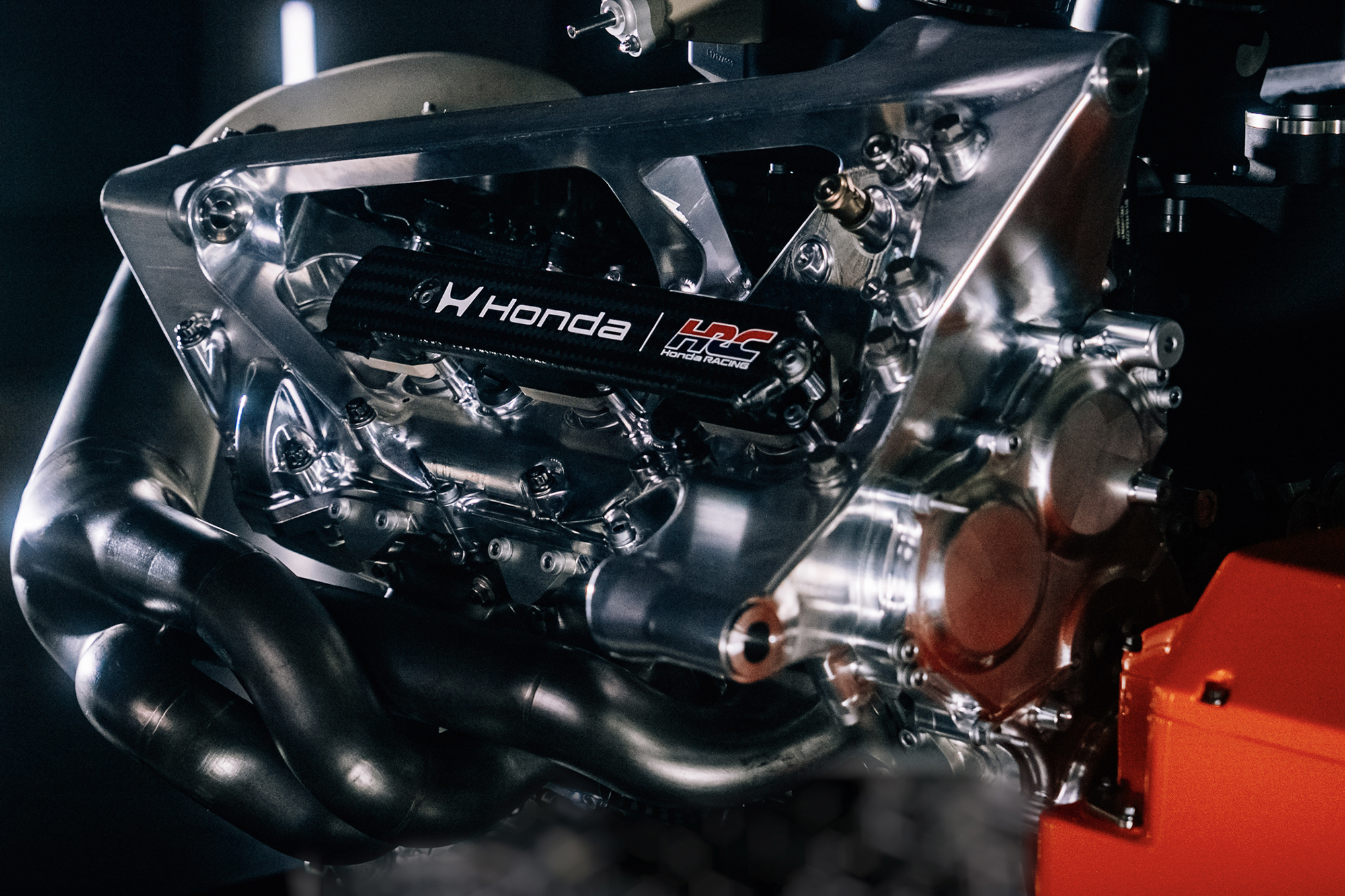
The new, much larger battery and control electronics was evident in the images Honda released of its new engine. Likewise the larger MGU-K has to be repositioned now.
The consequences of no MGU-H
The absence of the MGU-H has become a footnote in the narrative around the 2026 rules.
It tends to be mentioned in the context of making the engines simpler but, as Kakuda explained, there is a big consequence that has not really been discussed in much detail.
Beyond the fact the engines cannot recover energy in the same way as before, which is a problem given making enough energy available for the amount of power that can be deployed is expected to be a huge challenge, the MGU-H used to be twinned with the turbocharger.
More from Honda's engine launch
- Honda reveals new F1 engine with a key part hidden
- Where Honda stands on tough 2026 targets + compression ratio trick
It helped prevent turbo lag, which is the delay between a driver pressing the throttle pedal and the exhaust gases being able to spin the turbo, generate boost, and produce full power.
"There are also cases where electrical energy is used to shape torque characteristics or achieve peak power, depending on how the turbo and engine are designed," said Kakuda.
"With the MGU-H gone, turbo lag becomes a major issue, and using electrical energy to compensate for that is certainly an option.
"However, electrical energy is limited, you can't use it anytime, anywhere. So how you use it becomes extremely important."
Why fuel is so difficult
Honda is working with new partners in Aramco and Valvoline as part of the Aston Martin project.
Aramco is developing an F1 fuel for the first time, for the advanced sustainable fuel switch that is part of the new rules package.
This is expected to be a major unseen element of each engine's performance potential, with Honda previously working with ExxonMobil - thought to be the benchmark in recent years.
Kakuda said the fuel regulations are another aspect that have "changed completely".
"While we do have some knowledge, we need to start fresh in terms of how to match the fuel with new hardware and understand what effects are produced by different components," he said.
"That's why we really feel the difficulty of this as completely new development.
"With the strict constraints on producing and using fuel sustainably, fuel development becomes a battle of ideas and speed."
Hoping for battery advantage
One high-level source with knowledge of Honda from its Red Bull partnership had indicated late last year that Honda was struggling with its new battery.
The demands of the new MGU-K mean there will be differences between engines in terms of energy loss and deployment - and degradation as the parts get older. Batteries further into their life cycle will not recharge to their theoretical maximum.
However, Kakuda said battery technology is "an area we're confident in", based on Honda continuing battery development outside of F1 even while its F1 R&D activities were halted in 2021 and only really resumed fully in 2023.
Asked if Honda's apparent performance advantage from the previous generation of engine could be carried over, he said: "That's what we believe and hope."
One distinction to make though is that while the technology could be fine, the concept of Honda struggling could relate to the size and weight of the battery. It has shown off how large the new 2026 modules are - but we have no reference from another manufacturer for comparison.
Reliability the focus now
Engine manufacturers need to homologate their designs for this year by the start of March. Honda's focus before then is now on reliability, Kakuda revealed.
"However, there are many things you can only learn by installing the power unit in a car and actually running it," he said.
"That's why winter testing, mounting it in a real car or one that's very close to race conditions and confirming that everything operates properly, is an extremely important task, and that's the stage we're at now."
It had a disastrous start to its entry into F1 the last time there were new engine rules, having joined the V6 turbo-hybrid era a year late in 2015. Another design overhaul in 2017 also led to a nightmare experience in testing.
By the time its 2021 redesign came around, the Honda project was in much better health, and there were no such problems. Where the 2026 engine will end up compared to its predecessors is a big unknown but Kakuda did not expect "failures on the same scale" as 2015 and 2017 because that related to the now-abandoned MGU-H.
"This time, we don't have those unknown rotational speeds or extremely complex mechanisms," he said.
"That said, there are still definite challenges. For example, with the increase in electric output, the effects of high torque on the MGU drivetrain become a difficult area.
"Thermal management and temperature control of the battery and motor are also areas where each PU manufacturer may take a different approach, and that will inevitably affect reliability."