Ferrari is fastest in Mexico - but not for reasons rivals expected

Ferrari’s rivals were right after all, but perhaps for the wrong reasons.
The talk ahead of the Mexico Grand Prix had been that Ferrari’s smaller turbo design would give it a clear advantage at the high altitude track because it would in theory struggle less in the thinner air.
So there was little surprise in the paddock when Charles Leclerc delivered a clean sweep of fastest laps in both FP1 and FP2 on Friday - confirming the Prancing Horse as the team to beat.
What was perhaps more interesting from what we saw though - and which could play a big role in how the rest of the weekend plays out - was that Ferrari’s advantage was not coming from its turbo getting its boost pressure up quicker.
Ferrari’s straight-line speed performance was notably lacking on the second and third straights. On its soft runs Leclerc was slowest of the top four teams into Turns 4 and 12.
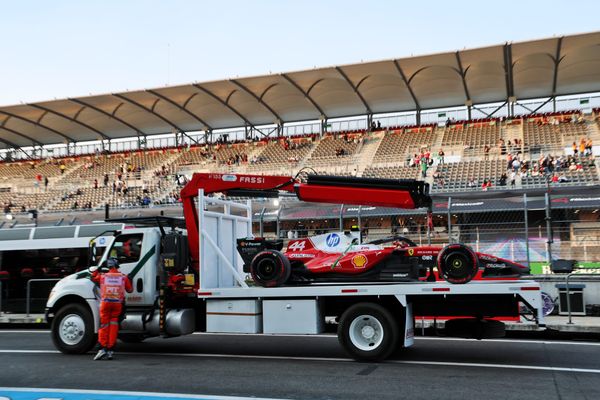
As Lewis Hamilton, who was sidelined by a suspected power unit problem halfway through FP2, remarked: “If you look at the speeds to the Mercedes and the Red Bull, they're still massive.
"They're still quicker at the end of the straights, like they are in every race. So the turbo is just not making a difference. They are still pulling more at the end of the straights.
“I think we're still losing a good two or three tenths. But the car is behaving really well fundamentally. Our car works really well, seemingly on a track like this.”
Ferrari’s advantage in Mexico instead was coming from an area it has excelled in all season - low speed corner performance.
It was just marginally better through the first two complexes of corners (Turns 1-3 plus Turns 4-6) as well as taking a decent chunk out of the opposition from Turn 12 into the stadium section.
That trait meant that Leclerc had the consistency needed from the tyres to deliver the strongest long run of the afternoon - leaving rivals in no doubt about who was the benchmark.
What the long runs say
But while the opposition clearly was happy to put that favourite status on Ferrari, that does not necessarily mean that all hope is lost for everyone else.
Others certainly saw enough in the data to think that there remains a big opportunity to fight at the front.
When we look at the long run averages, Lando Norris in the McLaren, plus the Mercedes and Red Bulls were not far behind what Leclerc delivered once you factor in the influence of cool down laps and traffic.
Mexican GP FP2 long run averages
Russell (soft): 1m21.442s
Antonelli (medium): 1m21.487s
Leclerc (medium): 1m21.163s
Piastri (soft): 1m21.642s
Norris (soft): 1m21.319s
Verstappen (soft): 1m21.490s
Hadjar (soft): 1m21.369s
It was a day where certainly not everybody delivered to their maximum, as drivers battled brake locking, bumps and rapidly rising tyre temperatures.
George Russell said: “Ferrari looked very strong and that was kind of the anticipation ahead of the weekend
“I think we are still not fully on top of the new package, I think we see there's some balance limitations we have that we're struggling to overcome.
"I would say currently for Kimi and I, we're probably more outside the window, similar to what we saw in Malaysia, than inside the window like Kimi [Antonelli] achieved in Austin. Hopefully overnight we can get it back there."
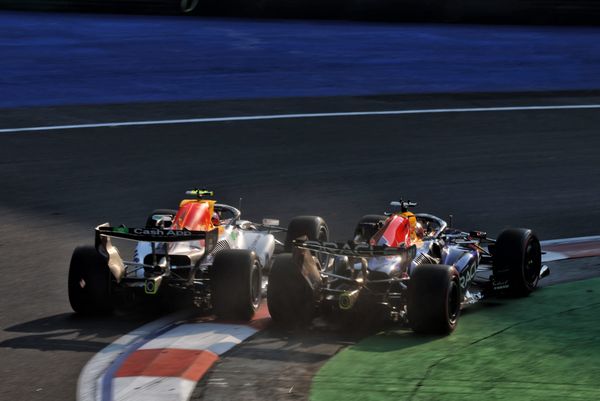
Things perhaps being a bit closer than they look at first glance is even more in play when you take into account that Verstappen’s afternoon was derailed by his clash with Liam Lawson that damaged his floor.
That left the Dutchman battling a disconnected balance throughout his long run as he was lacking some key parts - so you could anticipate a potential improvement there.
As Red Bull’s technical director Pierre Wache said: “Let's see tomorrow when the floor will be repaired and how the car is better or not.”
Wache certainly felt that Ferrari was not out of reach, especially considering it has been strong in the types of turns that Mexico is full of.
“I think in low-speed corners, since the beginning of the year, they are clearly on top of the game, and they have clearly a lot of downforce for low speed. After, let's see what we can extract. I think we are not far, and hope we can challenge them.”
Ferrari's chief concerns
While the indications are of an early Ferrari advantage based on what we have seen so far, there are some important factors that mean it still cannot sleep easy tonight.
The first element is that the long runs on Friday may not be totally representative of how things will play out in the race because of track temperature variations.
The late start for FP2, allied to conditions being a bit cooler, meant that the track surface was not as hot as it will be on Sunday.
Wache said it was not nailed on which would be the optimum tyre for the race.
“The tyres are overheating in the last sector,” he said. “Clearly, the main problem is in FP2 where the track [temp] reduced by more than 10 degrees.
“For the long run it was not very representative of what we'll see in the race Sunday. Then we have to be very careful on that aspect. So the deg will be higher, and maybe the medium will be better.”
The premium on cooling around Mexico means that the pace of the cars is limited more by managing that than their theoretical best - so that could have a big impact too on how things play out on Sunday.
Overtaking is already difficult here and following close behind a rival becomes far from ideal because of the consequences of engine and brake temperatures - so it is rarely a race where cars come through the field for the win. Clean air is invaluable.
The need for Ferrari to not be in the pack is further increased by its expected turbo advantage having not manifested itself with superb top speed - something rivals were happy to see.
As McLaren’s Oscar Piastri said: “I don’t think the turbo’s going to make as much of a difference as we thought.
“They if anything looked a bit slow on the straights so, let’s wait and see tomorrow, definitely in some circumstances it will help them but I think in normal conditions it’s not as big of a factor as we first feared.”
All on qualifying?
Put the 'track position is king' element on top of a likely one-stopper where there will not be strategy variation and it puts a huge premium on single-lap pace and delivering what is needed in Q3 to take pole position.
And how many Fridays this season have ended with Ferrari topping the timesheets, looking to have the long-run potential, but then falling flat when things get serious on Saturday afternoon? We only need to go back one weekend for the last time that happened.
Ferrari knows it has a weakness on Saturday based on it not being able to get its tyres as perfectly into the operating window as its rivals - and that could well prove critical in that fight at Mexico.
As Hamilton remarked after practice: “I think the car feels like it's capable of competing in qualifying. But I don't know what it is they [the others] do in quali. Everyone seems to take a step. I don’t know if we can eke out a little bit more tomorrow.”
At a track where the lack of downforce means tyres are sliding a lot more, everything may well come down to looking after those rears.
Even Norris, who was second quickest in the afternoon, reckoned that the key would be delivering at the right moment.
“The pace is definitely there but the field is incredibly tight at the minute, so it will come down to execution in tomorrow’s qualifying,” he said.
Ferrari team boss Fred Vasseur knows that rivals have maybe not got things together as well as hoped on Friday and will come back stronger.
So with things looking as tight as they are, amid what he says are “mega extreme” conditions, the fight for pole - which could be critical to the win - may well come down to simply who can keep their tyres alive the longest in qualifying.
“It's always a challenge in Mexico,” said Vasseur. “I think it was last year that everybody was in half a tenth until Turn 10 and then you had four-tenths’ difference in two corners. I think it will be the same tomorrow.”