What F1 teams' Monza deployment patterns have revealed


The 2026 Formula 1 cars are at their most energy-starved at Monza since the in-season rule changes were agreed in April, and there are currently plenty of telling differences in energy deployment between the cars.
Teams - particularly manufacturers and their customers - often converge closer on energy deployment come qualifying, with more variance on Friday.
But there's still some interesting patterns we can see from analysing the data, the long run times and what the teams and drivers have said so far at the Italian Grand Prix.
Mercedes vs Ferrari
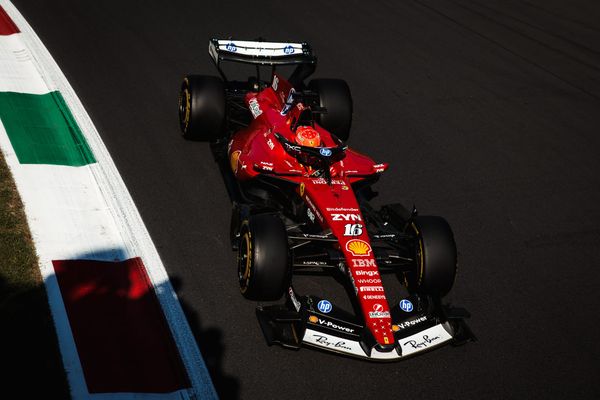
Ferrari has the benefit of its upgraded 'ADUO 2' power unit this weekend but, given the team's played down how big a step it is, there's no reason to believe Mercedes still doesn't have the benchmark 2026 power unit.
Russell vs Leclerc fastest FP2 times
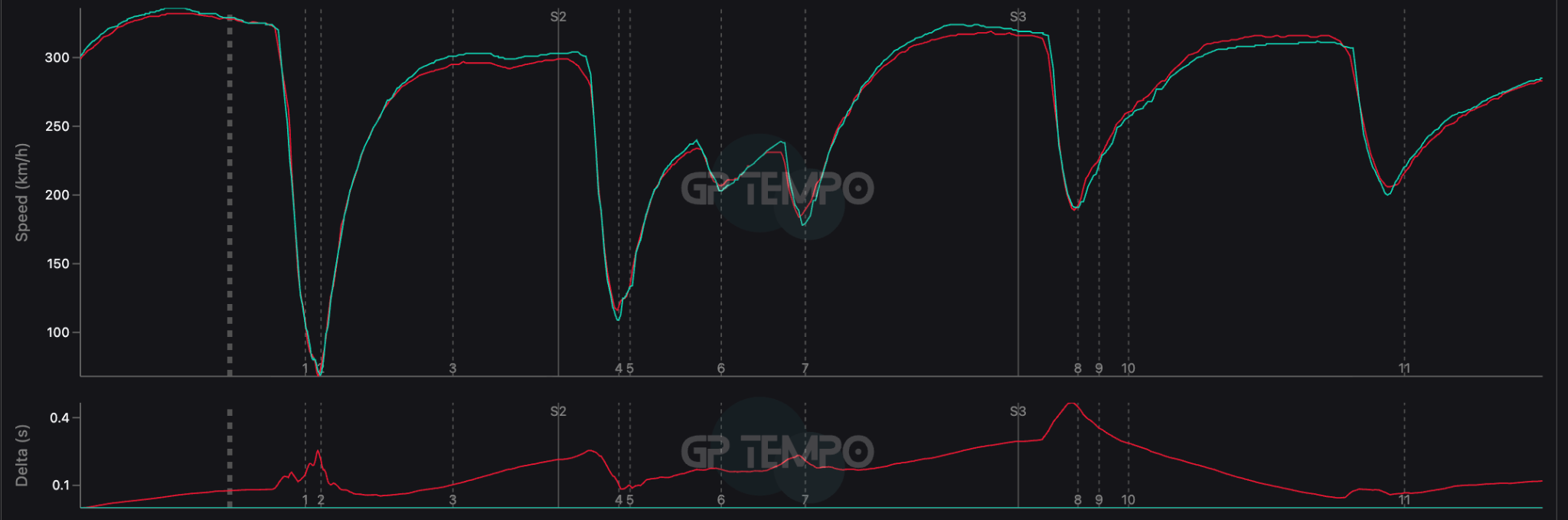
Looking at the GP Tempo data of George Russell's FP2-topping time (green) and Charles Leclerc's best (red; 0.120 seconds slower), you can see the Ferrari loses time to the Mercedes on the first three straights, to the point where Leclerc is 0.466s adrift on the entry to Ascari.
It's out of Ascari and towards the Parabolica (Alboreto corner) where Ferrari claws back most of that time - an interesting deployment split that, if maintained, would certainly make lap one on Sunday exciting. And you can add to that, as Alex Albon pointed out on Thursday, that "the Ferraris tend to be quite opportunistic in [the opening laps]; they run different modes, and they can catch other cars out".
Check out Edd Straw's analysis for a more in-depth look at Ferrari's start to the Italian GP.
How strong is the upgraded Ferrari engine?
Comparing the Haas drivers does give you an unusual opportunity to assess the upgraded Ferrari power unit as Ollie Bearman has it and team-mate Esteban Ocon doesn't.
Though that does come with the caveat that Ocon was suffering from the parts inconsistency issues that have hurt Haas all season.
Those inconsistencies often result in a loss of downforce or feeling that will certainly explain a lot of Ocon's one-second deficit to Bearman - who was eighth fastest in FP2.
But the straightline speed difference between Bearman (purple) and Ocon (white) is noticeable on the run to both Ascari and into the Parabolica.
Bearman vs Ocon fastest FP2 times
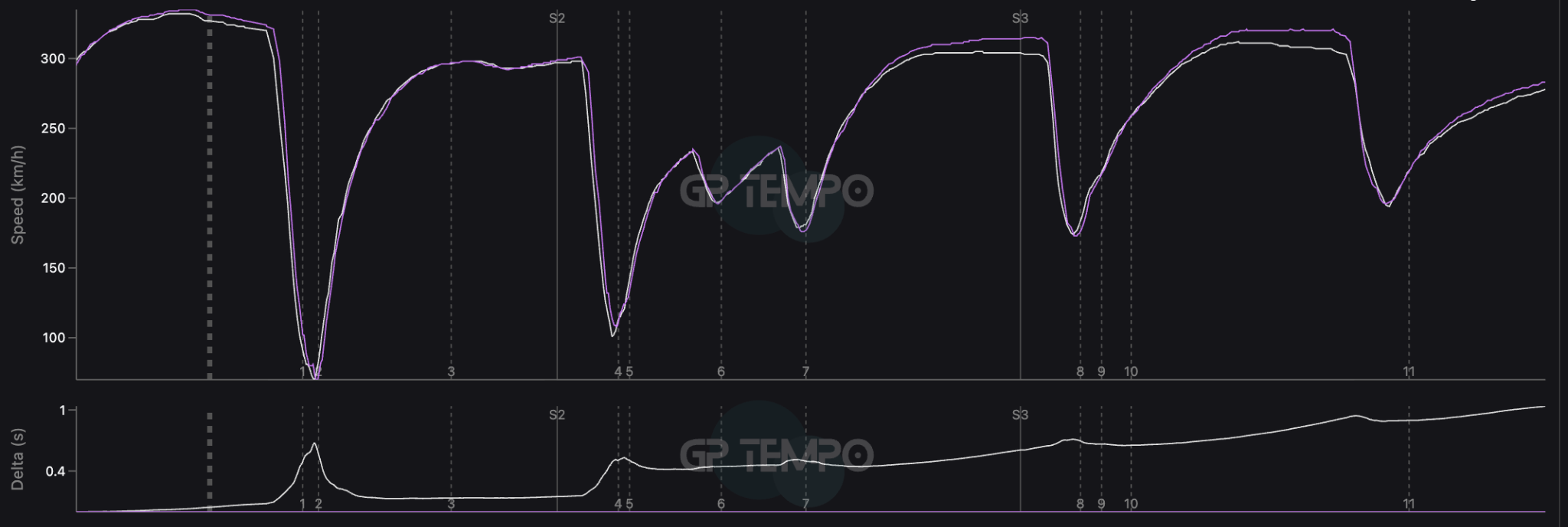
Really, we'd need those parts inconsistencies to be solved to know the true difference in power units.
Certainly Haas's aero upgrade (which is on both cars) is performing well with what Bearman described as "the best Friday" since March.
That's sorely needed as Haas has long drifted outside of points-scoring contention, having not scored at the six rounds since Monaco in June.
Where McLaren is lacking
McLaren's expectations of a tough Monza look correct based on its Friday performance, where Lando Norris was almost four tenths off Russell on single lap pace, and slightly further away on long-run pace.
McLaren’s technical director for engineering Neil Houldey said: "From an energy perspective, we've still got a bit of work to do.
"There's certainly laptime there available to us, a little bit moving around recharge, moving around deployment."
The GP Tempo data certainly supports that when you compare Russell (green) and Norris (papaya).
Russell vs Norris
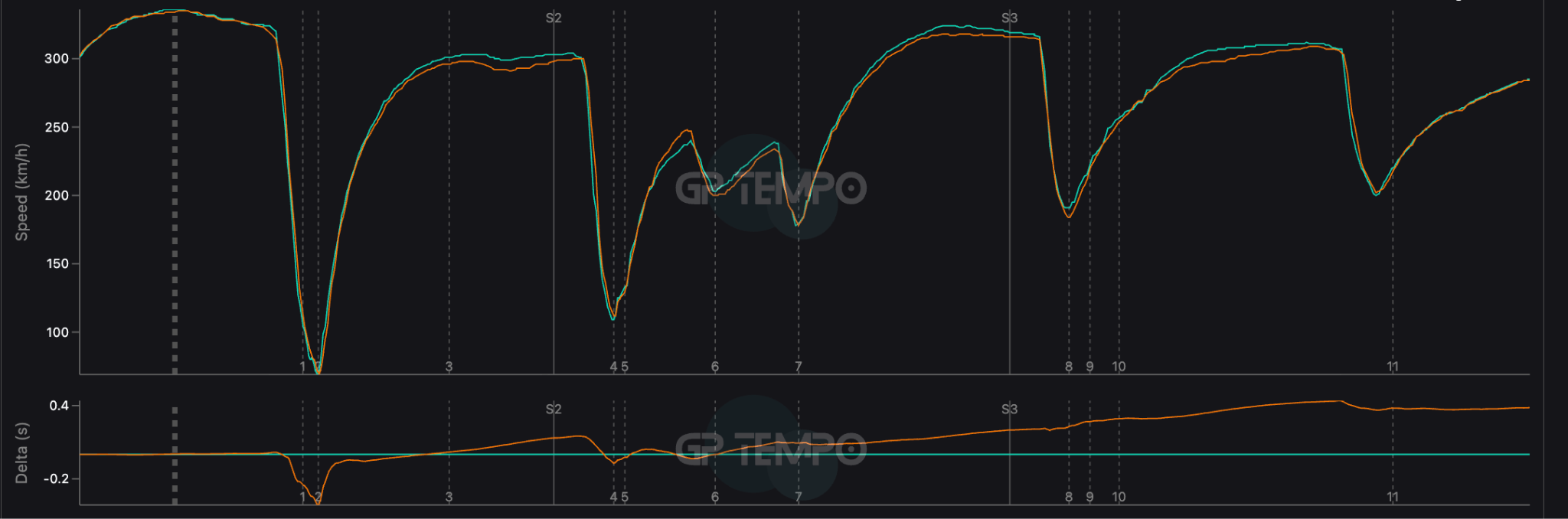
Even with the same power unit, McLaren is losing out on the three long straights after Turn 1 - with the run to Parabolica particularly painful.
We have seen plenty of times this year quite different energy deployment strategies between Mercedes and customer McLaren on Friday, before McLaren learns and starts to converge by qualifying.
McLaren did successfully run the modified version of what it's dubbing its "H-wing", with "no reason to take it off" unless the team has suddenly found something wrong in the data overnight.
Norris summarised: "We'll see what we can change overnight, but we're not in as good a position compared to the last few weekends, so, yeah, tough."
Its shorter gear ratios won't be helping it here either. It knows it pitched them wrong this year, but it doesn't want to use its one joker to change them (as Audi has) because of the cost, which could instead go to aerodynamic upgrades.
Red Bull is in a similar position and will have needed a fruitful overnight period if it's to have any chance of joining the Mercedes/Ferrari fight. The only silver lining for the team was Verstappen's solid long run where he was only three tenths off the Mercedes, which probably underpins technical director Pierre Wache's hope that a podium is still possible if Red Bull takes a step forward overnight.
Honda's 'Spec 2' is still lacking
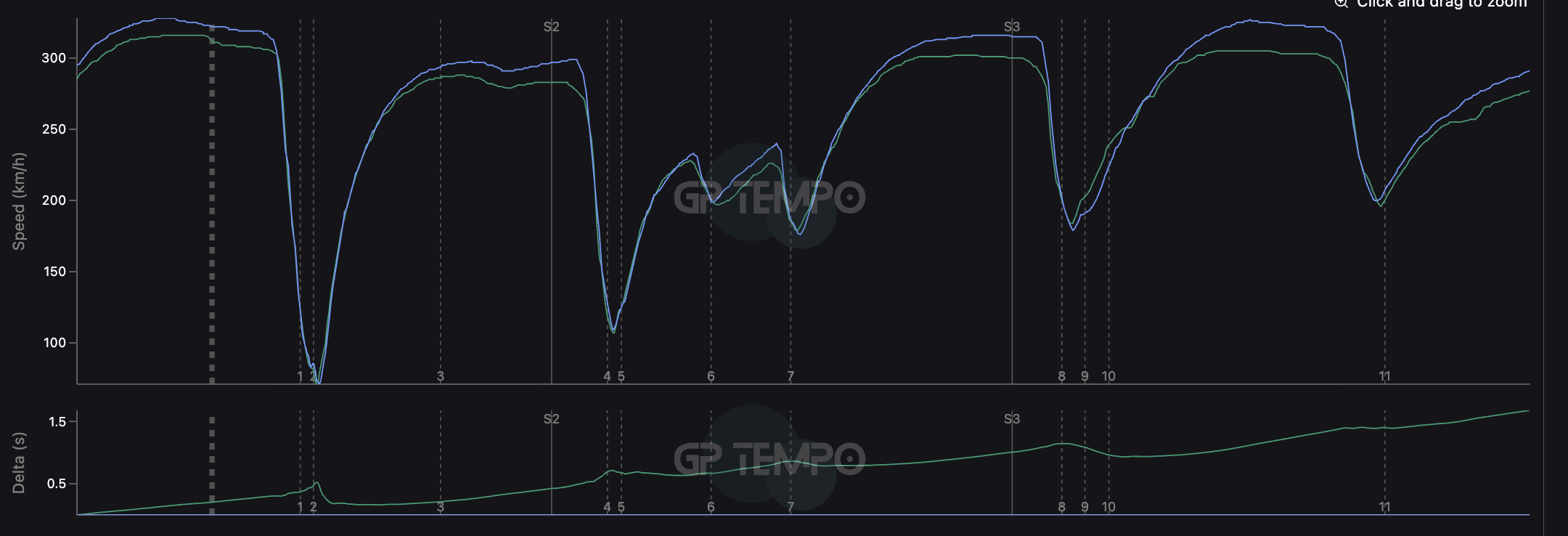
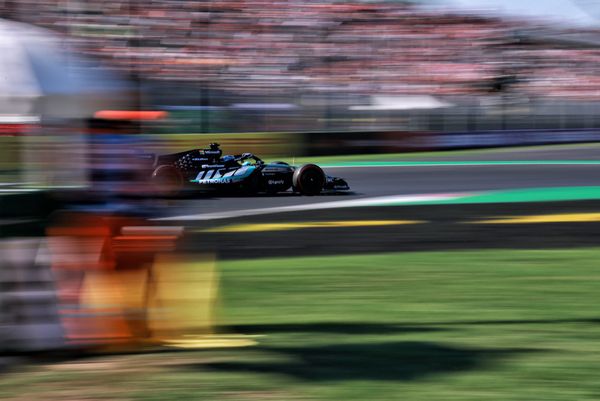
This is the worst-case scenario circuit for Aston Martin-Honda, given its sizeable power unit deficit - one that its upgraded 'Spec 2' engine hasn't solved.
Looking at Fernando Alonso's best FP2 lap versus midfield leader Arvid Lindblad's, there are clear major losses on every straight.
Alonso loses four tenths on the run to Turn 1 alone and a whopping half a second from exiting Ascari to Parabolica.
Honda's chief engineer Shintaro Orihara said: "As we can see from the results, our straightline speed isn't enough compared to our competitors.
"This isn't a surprise, and we knew this was coming at a circuit where the power unit performance is so important.
"Therefore, this track presents a challenge for us. We will optimise our settings to maximise our performance as much as possible, but we should remain realistic for what’s to come."
What's to come is likely a fight with Cadillac and potentially Williams to avoid returning to the back of the grid this weekend after the Zandvoort ninth-place watermark.
A very different Monza
As expected, the GPS data of a single lap around Monza looks very different to one year ago.
There's a night-and-day difference when you look at Norris's FP2-topping time from 2025 (orange) versus Russell's 2026 FP2 benchmark (green) - with 2.681s between them.
Norris 2025 FP2 vs Russell 2026 FP2
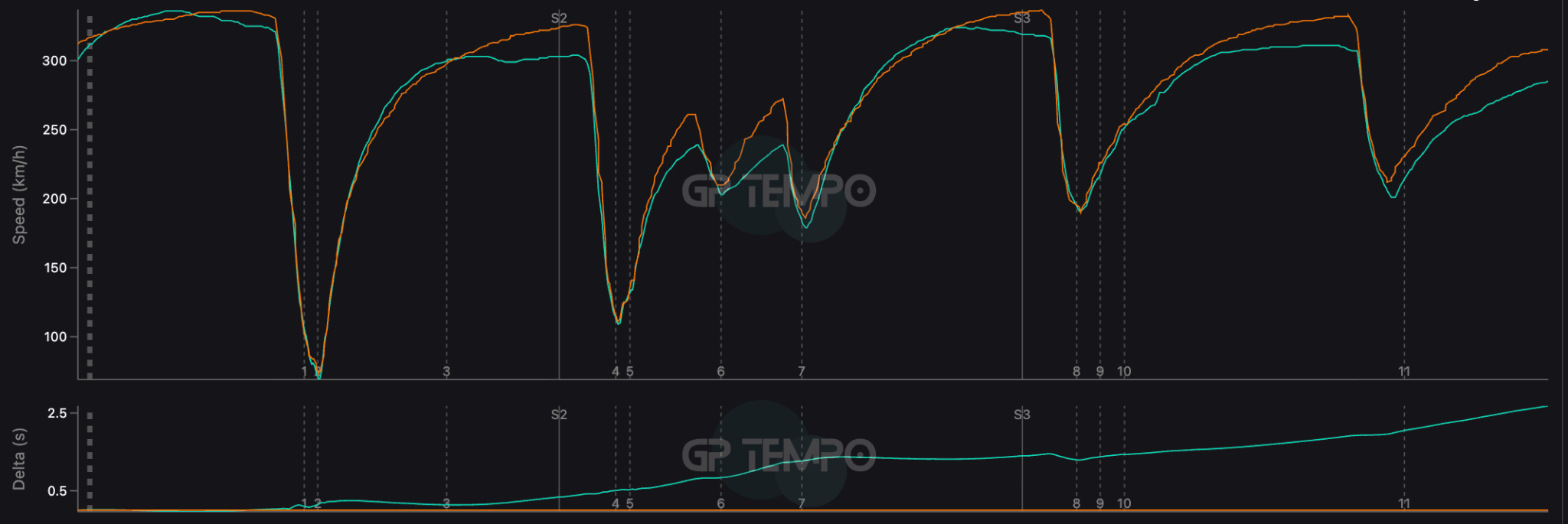
There's a sizeable difference in-between the Lesmos and on the run to Ascari, Parabolica, and the finish line.
There isn't the dramatic tail-off in speed that we saw prior to the in-season rule changes at the end of the straights, but rather a levelling off where they lose a lot of time versus one year ago.
On Thursday, Oscar Piastri said the speeds at the end of the straights in Monza in the pre-weekend simulations were slower than they were in Hungary - and that's proved to be the case on Friday, with Russell 6km/h quicker by the end of Turn 1 in Hungary than at the end of any of the Monza straights.
Given Pirelli is expecting Sunday's race to be an easy one-stop with tyre degradation minimal on Friday, differing energy deployment/harvesting strategies will once again be a critical factor.