F1 teams face big Madring strategy dilemma

Formula 1 isn't really heading for the six-stopper Spanish Grand Prix that George Russell half joked was on the cards after opening practice.
But tyre supplier Pirelli says a combination of factors at F1's newest venue means strategy is going to be particularly tricky to work out.
In fact, the initial prediction following Friday's running is that teams are going to be stuck between a rock and a hard place when working out what is best to do.
The super-long pitlane, which has left the pitstop loss time at around 24 seconds, is a deterrent for tyre changes and means the most logical route should be a one-stopper.
But high levels of thermal degradation of the rubber, and particularly challenging front left graining, means that a two-stop would be sensible.
With no middle ground between those two choices, it is not going to be a case of what is the best strategy to pick. It is about which is the least bad.
Outside expectations
F1 teams were left wide-eyed after opening practice when the tyre degradation looked pretty extreme.
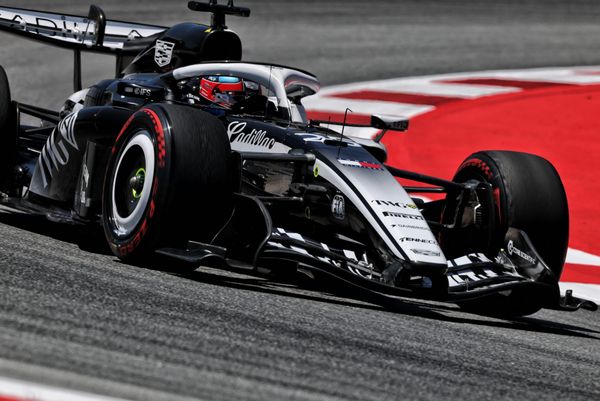
A combination of high grip asphalt (highest of the season according to Pirelli), a smooth surface and fast corners has meant cars are sliding a lot – and that triggered some alarming findings during that first session.
As Russell said: "It's often a possibility on new tarmacs that the grip is very high but you're sliding quite aggressively.
"With the deg we had in FP1, a six-stop race would have been the fastest way. FP2 was slightly better and I'm sure the race on Sunday will be better again. But that's the biggest question mark."
From Pirelli's perspective, there are two issues that drivers and teams are going to have to manage as the Spanish GP weekend continues – and neither is particularly straightforward.
The most complex issue is front left graining, which is being generated because the combination of the smooth surface and high grip means the rubber hits peak stress easily and the surface effectively tears.
Front graining triggers mid-corner understeer and a subsequent drop in performance. It is much harder to manage on the kind of high-speed corners that feature at the Madring than it is at low-speed venues.
Oscar Piastri said after Friday that this element had been the biggest headache from running.
"It's been a nightmare to try and manage the tyres with graining," he said. "It normally gets better through a weekend, but we'll have to wait and see how much better."
It is not just the fronts that are proving to be hard to deal with around the Madring, because the high-speed corners and the way the cars are almost constantly in turns means that the rears are overheating too.
Throw these two elements together and the result is high degradation.
Pirelli chief engineer Simone Berra reckoned that the drop off here was at a "very high" level – around 0.2-0.3 seconds per lap based on some of the long runs in FP2.
"It was a surprise to have these kinds of values," he said. "They were outside our range of expectations."
While general track evolution and improved set-ups should help reduce that figure by the time the race comes around, the scene is set for the Spanish GP turning into a race where tyre strategy will be critical.
That is what has fuelled all teams apart from Audi electing to keep two hard tyres back after Friday practice – as that could well be the most resilient option for Sunday.
Berra said that the unpredictability thrown up by the front graining and overheating, plus the levels of the degradation, meant that plotting the right path through the race was going to be tough to nail.
"I don't want to exclude any kind of situation," he said. "I think looking from the data, you would think that the teams will go for a two-stop because the degradation is very high.
"But the pitstop loss is 24 seconds, so I'm pretty sure that some teams will try to reach as a target the one-stop race.
"It means we could end up in different situations, with some teams trying the one-stop and other teams trying the two-stops."
Which route is best is unclear right now, and matters are further complicated by how difficult it could be to overtake.
For even though the new power units mean deployment offsets can make passes easier at some venues than in the past, equally there are downsides to falling into the pack.
Berra added: "If you are in traffic, you lose quite a lot of performance, and you also destroy your tyres because you lose load and you generate high temperatures as you're sliding.
"So, we have different factors that are pushing teams towards different directions.
"It's not easy; in fact, it is pretty complicated."