F1's take on its battle to satisfy new and old fans
Bernie Ecclestone once infamously said that there was little point in Formula 1 chasing a younger audience, because they could not afford what sponsors had on offer.
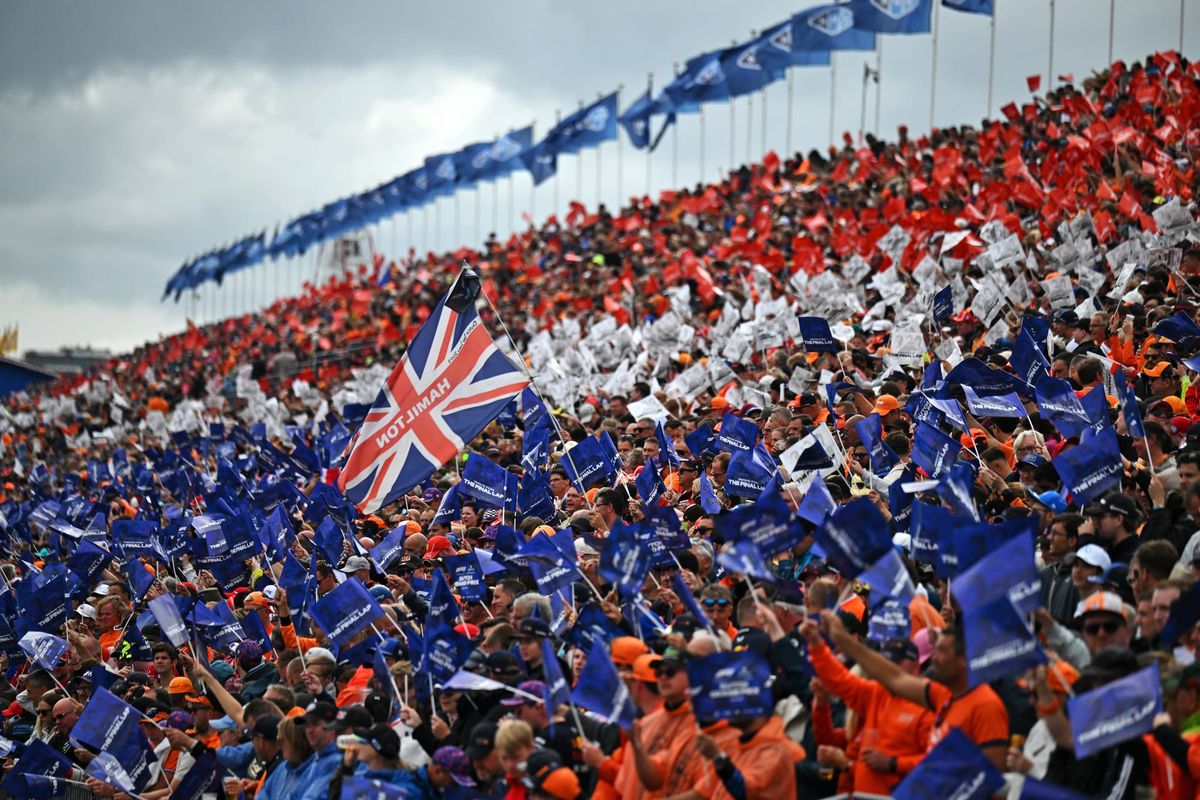
Now, well into the post-Ecclestone Liberty Media era, F1 not only has a bigger audience but a much younger one, too.
The latest figures issued by F1 suggest that 830 million people now follow grand prix racing, which is 64% up from 2018 when its current owner took over.
It is estimated that 43% of F1's audience is now under 35, with 42% of the audience female. Out of the new fans, three quarters are female.
While the numbers are a huge triumph for Liberty, they are also at the heart of a debate triggered by the divided opinion over the 2026 rules.
How much should F1 and its stakeholders obsess over the new audience, and what should you do about the fans who have long been there?
Turn off the hardcore, who will stick with you through thick and thin, then there may be nobody left if the bubble bursts and the casuals are lost, too.
Widening the access
Those notorious Ecclestone remarks about younger fans came just as F1 began its hybrid era back in 2014.
"Young kids will see the Rolex brand, but are they going to go and buy one?" he said back then. "They can't afford it. Or our other sponsor, UBS - these kids don't care about banking. They haven't got enough money to put in the bloody banks anyway. That's what I think."
F1 is in a very different place right now, thanks to the new approach taken by Liberty.
According to FOM's chief communications and corporate relations officer Liam Parker, this wasn't an Americanisation of F1.
"It was a modernisation approach," he told The Race.
There was a time in the 1980s when all F1 had to really care about was making sure it was in front of as many TV eyeballs as possible on Sunday afternoons.
Ecclestone's approach to maximise the audience and the value for broadcast deals was to lock down the distribution of content to increase its exclusivity.
His successors – then-CEO Chase Carey and commercial chief Sean Bratches – viewed things differently. Rather than shut off everything on social media and view it as the enemy, they embraced it and saw opportunity.
Parker says: "Their view was, 'well, look, we've got access to all of this. How can we cut this in different ways?'.
"'Why don't we have a social media team that is large enough to service a wider audience? Why are the teams not allowed to post content? Why are the drivers not allowed?'"
It was this mindset that opened the doors for a different approach through social media and paved the way for the Netflix: Drive to Survive show that had a major role in delivering a new audience.
While Drive to Survive was important in attracting a new F1 audience, it should not be viewed as the magic bullet that did it all. Instead, it more amplified F1's new Liberty Media approach.
Parker adds: "A lot of credit is given to Netflix about what it did, and it deserves it, but it wasn't the panacea.
"I genuinely believe the opening up of social media access, alongside the Netflix environment, that then built into the F1 film and other things, shifted the demographic quite substantially. That's taken time."
What a new audience means
When audiences and customers change, organisations must react.
There is always a balancing act required in responding to what your new followers want without it risking being a turn-off for those who have been around a while.
In F1's case, it has been able to satisfy different segments quite easily off track by simply expanding the content on offer.
There are those happy to follow F1 simply through watching 15-second TikTok videos, while those that want technical analyses that pore over the finest of details can find that, too. One offering does not come at the expense of the other.
As Parker says: "If you just rely on, ‘let's just put out racing content', you're serving a certain market and hoping that the new market will just like that.
"You've got to keep up with trends. You've got to work out where the trends are.
"There's no point saying, ‘OK, we've got a growing fanbase aged between 16 and 20,' without saying, ‘well, what do they consume? How do they get their information? How do they get their entertainment? What news do they consume? What are they interested in and what are they not interested in?'"
It is here where F1 faces a bit of a juggling act because different audiences value different content in different ways.
For some, Lewis Hamilton's latest clothing choice is as important as the latest rear wing design is to others.
"If you talk about tyres and degradation in a video, then there's a whole load of people that just don't understand it," adds Parker. "They perhaps feel stupid and then don't want to be a part of it.
"They just want to know that Charles Leclerc turned up with the dog today. How big is George Russell's fiancée's wedding ring?
"That is just different content. What we shouldn't say is 'this [bit of content is] trivial, and that bit is far more serious'."
The hardcore vs casual debate
Varying needs of different audience segments go beyond just content though, because the make-up of the fanbase inevitably feeds through to what shape F1 itself should take.
When it comes to deciding rule changes, a key factor is always whether fans will like them or they'll prove to be a turn-off. And you are never going to please all the fans all the time.
There are times when a series has to decide whether it moulds itself into becoming what its fanbase wants, or if it commits to doing what it thinks is best and expects the audience to adapt.
This is something that F1 has faced head-on in 2026 with the new regulations having clearly divided opinion between audience segments.
Some have embraced the action-packed overtakes that many F1 drivers and hardcore fans have bemoaned as fake. Many could also not care less about the cars being energy-starved and how super-clipping has ruined some great corners.
F1 CEO Stefano Domenicali recently caused some controversy as he upset established and new fans alike in response to a question about the more hardcore of followers not liking the new rules.
"There are diehard motorsport fans who talk about clipping during a Formula 1 weekend," he told De Telegraaf. "But there will also be many who think of a clip as something you put in your hair."
Coming off the back of a comment he made over the summer that "no one is interested in how you drive the car", Domenicali's stance has left many long-term fans questioning whether they are now just a minority that F1 no longer cares about.
Parker is clear that is not the case - and he suggests Domenicali's hair clip remark was misinterpreted.
"I was in the room, and Stefano wasn't dismissive," he said. "He explained that he was a super fan, but he also had to think about those that are not.
"There's a great set of people out there that are our core, that care about clipping and battery state and charge, and you must give them that content.
"But there's others out there that think a clip is what you put in your hair. He wasn't saying that no one cares about super clipping. It's just different content ignites different people in different debates."
Not messing with the rules
Parker is adamant that while F1 has not hesitated to rip things up when it comes to content, there is a red line that it will not cross.
It is that grand prix racing must remain a meritocracy where the best drivers in the best cars come out on top. The sport will always come before the entertainment.
"The sport is the core," he said. "You can't mess with that."
Parker says evidence of this being central to Liberty's remit is that, while it's not afraid to shake up the experience for fans at grand prix weekends, the on-track elements have not been radically overhauled.
"I bet if you went back 10 years and asked someone to crystal ball gaze and say, ‘what do you think Liberty as an American company would do to F1', you'd say 'they will probably have sprinklers and have fake this and fake that'," he said.
"I think the most ambitious thing we've really done on track is to evolve the sprint races over time."
For F1, delivering a quality spectacle that stays true to its roots is something that is good for all fans.
"If that's strong, then everything else has a strong basis," added Parker.
"If people are saying that racing is rubbish, the drivers are boring, there's no entertainment, these cars are not interesting, then there isn't a Netflix story, there isn't a social media story."
But he says that F1 must be mindful that it cannot stay locked in the past. It has to evolve and adapt to ensure that there is a new generation of fans coming through, otherwise global interest will fall away.
"If F1 works and is fundamentally strong, then everything else goes from it," he said.
"There are fans that have been with us a long time, and they are vital. Hopefully they will be with us all the way through.
"But we would be wrong to say that, as a sport, all these other people that don't understand the technology, 'we don't want you'. From a sporting perspective and potentially a commercial perspective it would be stupid.
"I know sometimes it gets lost in understanding, but Stefano has been in the sport for 30 years, it's his business, but he's got to think: 'How do I make it bigger? How do I grow?'
"Because if you sit still, the NBA, cricket, football, everything else will grow, and we'll be left behind."
Sitting still is not something you'd associate with the Liberty F1 era, but keeping that much more varied audience – rather than winning it over in the first place – could be its greatest challenge yet.