Audi's 'terrible' headache has no quick fix
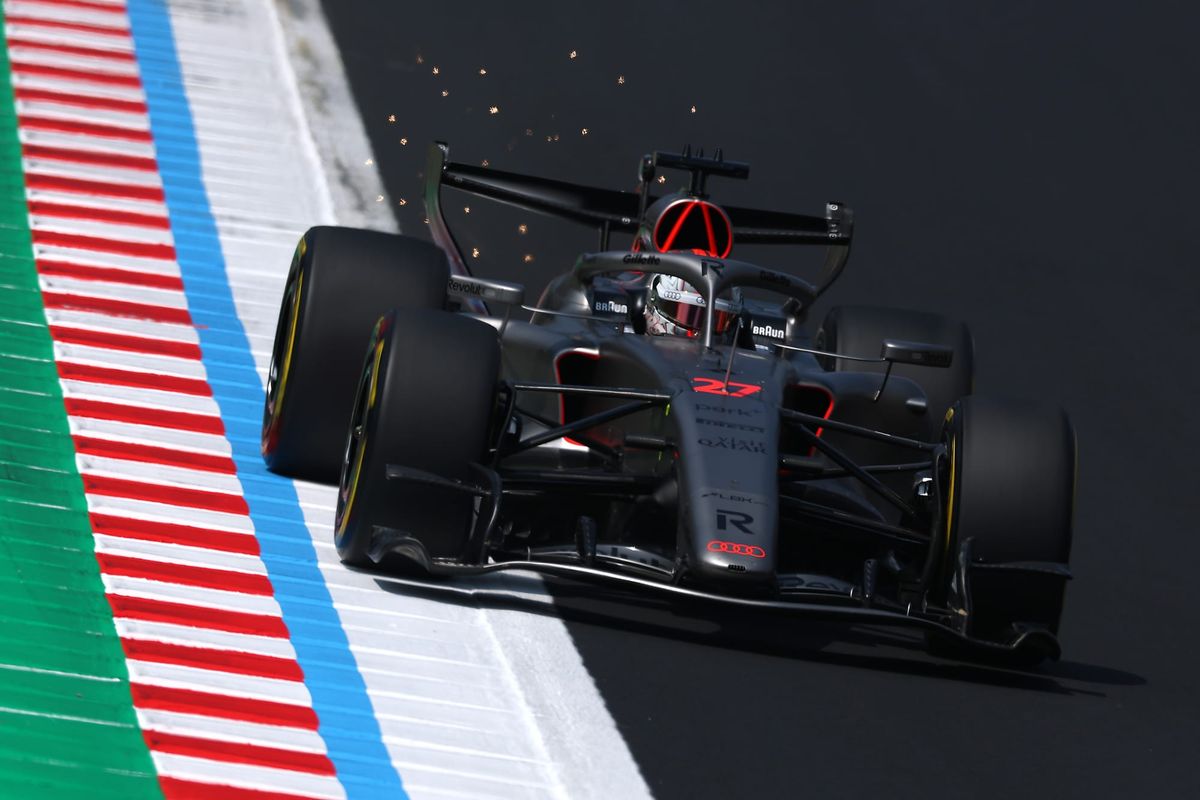
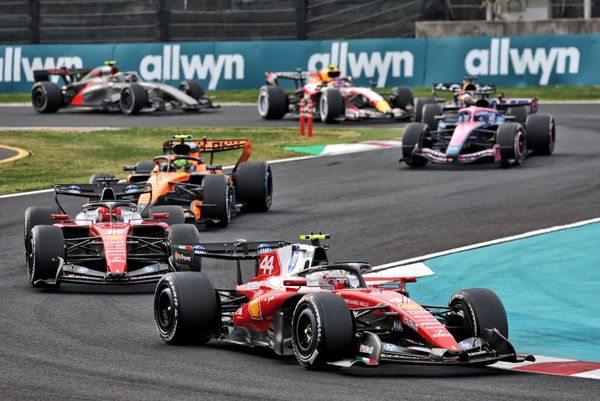
If it is accepted that Ferrari has the best starts in Formula 1 right now, few would argue that at the other end of the spectrum is Audi.
In fact, so repeatedly poor are its getaways that Gabriel Bortoleto labelled them "terrible" after he and team-mate Nico Hulkenberg lost a combined 10 places from their grid positions on the opening lap in Japan.
With all three grand prix weekends showing Audi's starts to have been poor, it has become clear that its launch problems are not just a case of dialling out early teething troubles with the new cars. Amid no sign of obvious improvement, something more fundamental is clearly in play.
As Hulkenberg said after the Japanese Grand Prix about a trend setting in: "It's obviously a thing."
This is why Bortoleto admitted following the Suzuka race that this would not just be a case of Audi needing more practice. Instead, this is a long-term project.
"We can improve a bit, but not in the short term to get to the Ferraris," he said. "It's very difficult also for Mercedes, so I think we are going to struggle a bit."
So what is triggering Audi's poor starts and why is it going to take so long to resolve?
The extent of the problem
Analysis of the starts of both Audi drivers so far this year highlights that they lose an average of four places over the opening lap.
Of the six times that Audi has actually been there when the lights have gone out (Bortoleto and Hulkenberg have both failed to start one race respectively), only once did either driver end the first lap further up than where they started.
That was Bortoleto in the China sprint, when it must be noted he was helped out by Isack Hadjar's spin that forced Ollie Bearman to take avoiding action.
That same race also included Audi's worst start, as Hulkenberg lost nine places, to prove that the problem is very much car-related rather than limited to an individual driver not getting on top of things.
To illustrate how things have gone, here is a run through of how Audi's opening laps have gone so far to highlight its start weakness.
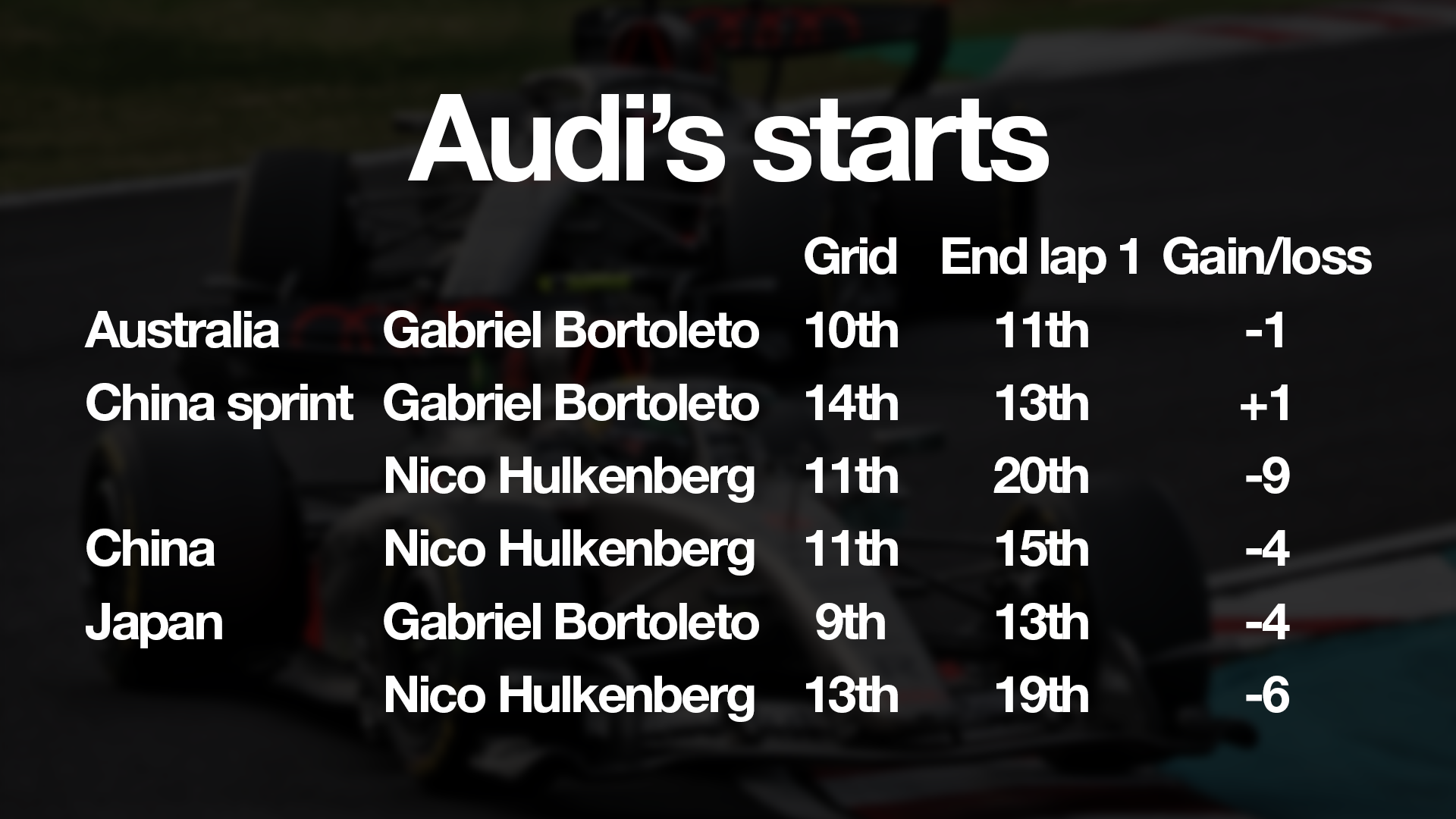
While Audi is not alone in having start problems this year - Mercedes has not yet converted any of its front-row lockouts into leading at the first corner - what is notable is that it appears to have made no progress.
Allied to Bortoleto's comment about there being no hope of a swift turnaround, it looks like the trend will continue for a while yet.
The engine concept influence
Start problems are not something unique to Audi as almost every team (and engine manufacturer) has faced some degree of difficulty.
The main challenge has been in getting the turbo spooled up to the right speed for the perfect boost pressure for a brilliant getaway.
The removal of the MGU-H for this season - which converted heat energy from exhaust gases into electricity - and rules that ban the use of the MGU-K to 'fill in' missing power until the car has hit 50km/h have led to some unintended consequences for race starts.
Drivers have found that the only way to get their turbo into the right operating window for a good getaway is to rev their power units up for around 10 seconds.
And that also needs to be done at the same time as ensuring the battery is as close to its peak - without hitting the limit - so it can then deliver as much power as possible for the second phase of the launch when the MGU-K does come into play.
The challenge of hitting the sweet spot with turbo speed is not equal across the grid, which is one of the reasons why there is such variability between teams.
It is widely understood that Ferrari's advantage at the start is down to some fundamental concept decisions it took with its power unit; in particular a choice it made in going for a smaller turbo.
The smaller turbo means there is less mass and lower inertia needed to spool it up, and therefore it is much easier to get it into the right rpm window.
It is the choice of turbo size that appears to be the key influencing factor in what is happening at Audi too, because it is understood to have gone in the opposite direction to Ferrari.
In fact, it has not only gone bigger - there are suggestions that it has opted for the biggest turbo on the grid.
That choice may bring its benefits - in terms of overall power on tap when up and running - but it comes with a big downside off the line in terms of making life difficult for Hulkenberg and Bortoleto to find the consistency needed with their turbo speed when the lights go off.
Asked by The Race about the starts being a consequence of design choices such as turbo size rather than procedures, Bortoleto all but confirmed this was the main factor - and that Audi perhaps never anticipated the consequences would be this dramatic.
"The procedure, I think, is very similar to everyone," he said. "I just think this is exactly what you said: I think there's teams that have developed the car in a bit of a different way to have better starts.
"I don't think any of the teams thought it was going to be that difficult to start. We ended up that it's terrible so far. We know it's very difficult for us, and we need to improve on that."
While more experience and more practice should help Bortoleto and Hulkenberg find some improvements to minimise the losses, if a full solution requires a turbo rethink, that's a much longer project.
Audi's F1 project leader Mattia Binotto said that the Japanese GP experience had shifted the start issue to the top of the team's to fix list, even if a solution may take a while.
"It's certainly not our strength at the moment," he explained. "The reason it has not been addressed so far is because there is not an obvious thing to be fixed.
"But on the other side, we know it's top priority for us, because we have good qualifying [pace] and it's not worthwhile starting there if you are losing all the positions at the start.
"So now it's good for us I would say, in a way, that two races have been cancelled. As a team we will have some more time now to reflect on the start of the season."