Gary Anderson's verdict on upgraded Audi 2026 F1 car
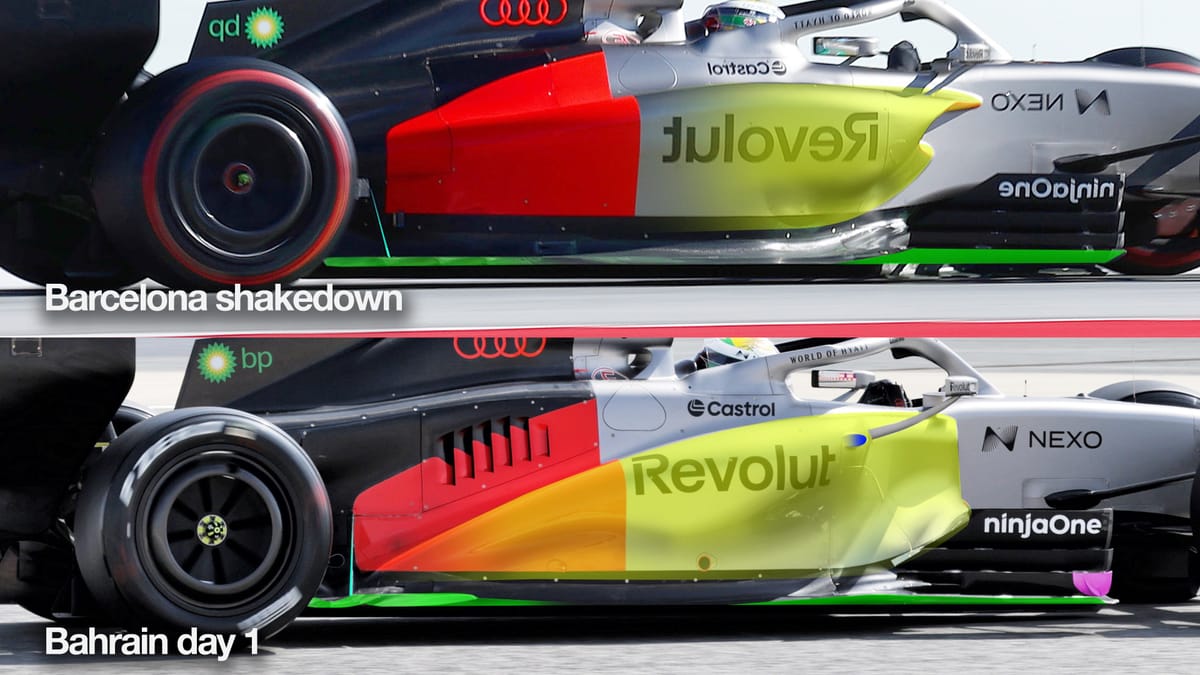
As Audi was the first team to run its 2026 car on track, it’s only right that it's the first team to hit the track with visible updates, most obviously a dramatic change to its sidepods.
The difference between what it ran in the behind-closed-doors Barcelona shakedown and this first Bahrain pre-season test is dramatic, but as you learn about these new cars it’s inevitably that’s what we will be seeing.
The front wing has changed as part of this new package. This comparison shows the Barcelona front wing (top) and the Bahrain version (below).
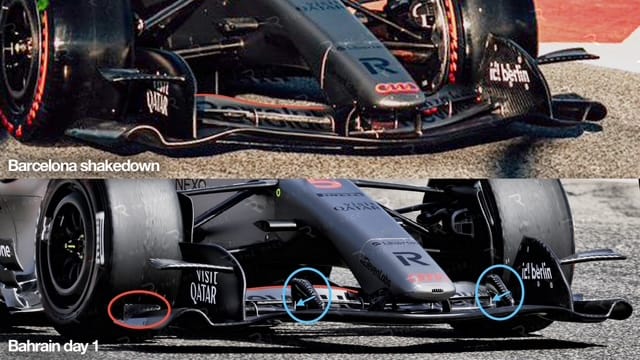
The mainplane and its swoopy profile look very similar, but Audi seems to have added a small turning vane (red ellipse) to the rear of the front wing endplate lower tunnel. The trailing edge profile of the rear element (red highlight) has also been altered so is now more loaded inboard. Both of these changes achieve more of that dreaded outwash.
I am assuming that these two components (light blue ellipse) are the front wing actuators and not something just being used for testing. If they are, then the small vertical link that has the light blue arrow pointing to it means that they will be opening both flaps. In other words, the slot gap between the mainplane and the second element will open for the straightline mode.
On most others, we have seen them dropping the angle of the two flaps or as Mercedes and Aston seems to do, drop the angle on the rearmost flap.
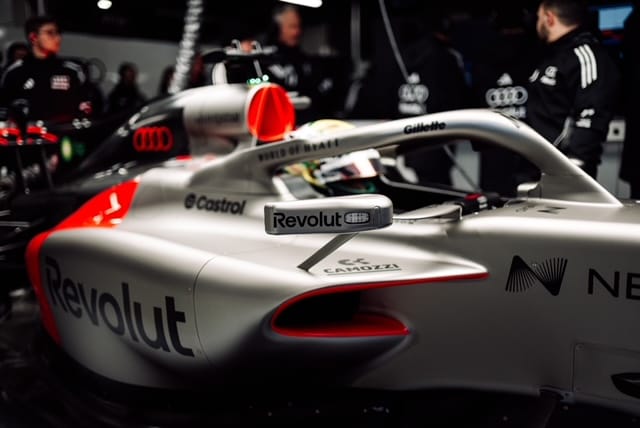
We talk a lot about airflow structure, which is how the airflow is affected by passing over the wing and body surfaces. This airflow also affects the performance of what’s behind it. So what’s coming along behind that front wing flow structure change? This shot is from Barcelona, and you can see that for this initial version it followed the path from 2025.
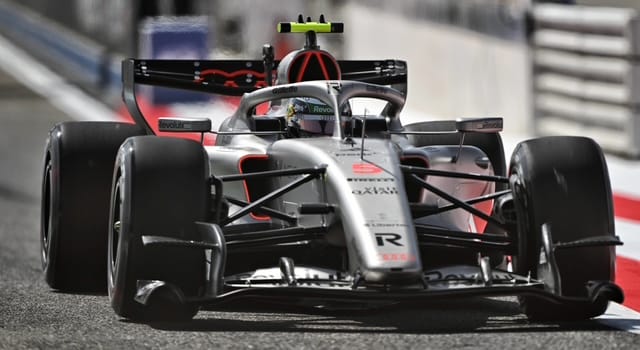
However, the lower shot from Bahrain shows Audi has now headed off on a tangent. It is very different visually, a bit lumpier and bumpier but not unlike the Mercedes zero-sidepod solution of yesteryear, and will have a major influence on the airflow structure around the sidepods.
One thing we need to remember is that for 2026’s active aerodynamics, the airflow coming off the front wing in straightline mode and cornering mode will be quite different. It’s not just about optimising the car for a small front wing angle variation for different circuits, this large front wing angle variation will be happening each lap.
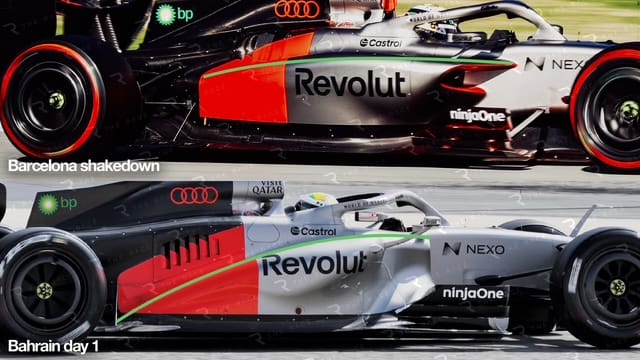
Audi has gone to more of a swept-down top surface for the sidepod as opposed to a more compact Coke bottle. This will help get more airflow down into the back of the car, improving the performance of the rear wing and diffuser. It also reduces the airflow around the side of the sidepod, airflow that can have a negative effect on the underfloor performance by getting pulled into the low pressure area underneath the car.
The bargeboards for this year were intended to create inwash. By regulation, they go outwards from the front corner of the sidepods to the rear outer sidewall of the front tyre. This is to contain the wake behind the front tyre and means that your own car suffers from that turbulence as opposed to sending it outboard for someone trying to overtake you to deal with.
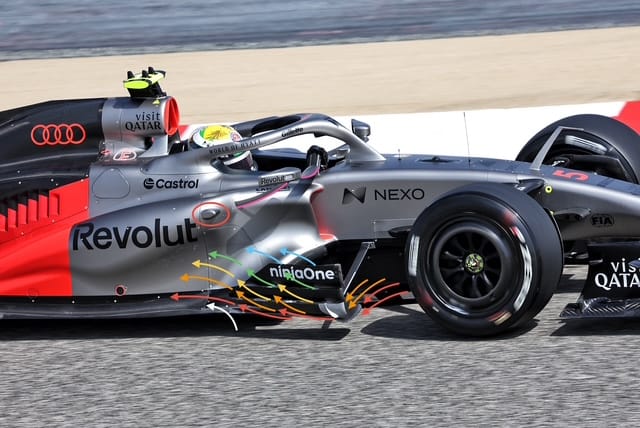
These arrows of various colours are to show how the teams are going about mitigating that problem. Basically, the fact the bargeboards, by definition, are wider at the front than at the rear means they will create a low pressure area behind them. These horizontal slot gaps allow airflow to be pulled through them into that low-pressure area and then let it join up with the airflow coming through the sidepod front corner undercut.
The curved white arrow indicates a small opening or inlet duct. I’m not sure where this will lead to, but it’s just part of the detail required to manage the overall cooling required for these cars.
You can just see how tightly everything is packaged. The red ellipse shows the cover of the upper foreword side impact structure. By regulation, it has to be enclosed in the sidepod body surface. I also love the detail of the mirror mounts (in magenta). It's this sort of detail on these current cars that we couldn't even have imagined about 30 years ago.
I’m also quite interested to see what Audi has done with the area below the radiator inlet. Between it and the floor entry, there is significant height available to exploit. It may just be a surface that creates a larger stagnation point to allow the underfloor to pull as much airflow as required for varying ride height.
It’s great to see something different, that said, it will be the stopwatch that confirms if it is just different or better.