Will this big upgrade swing a key F1 fight? Gary Anderson's take
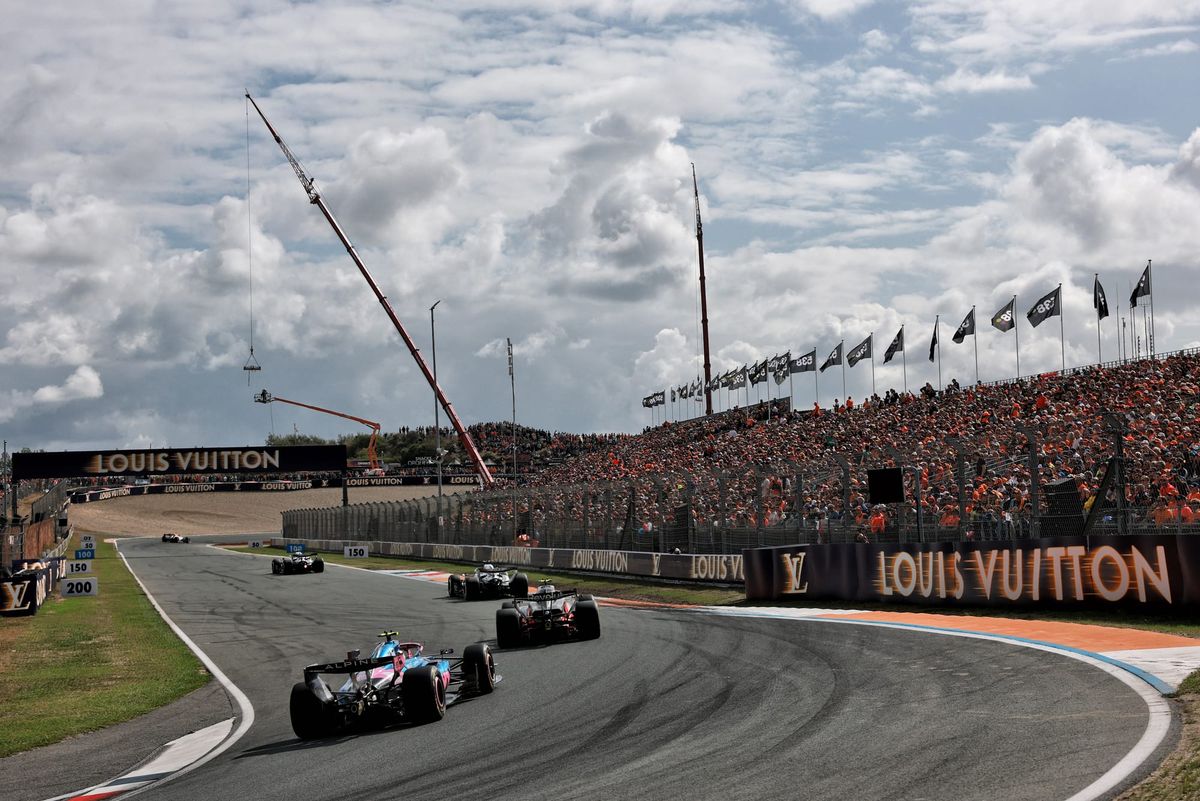
It’s true that the top four Formula 1 teams receive more coverage and column inches than the rest but the reality is that the mid-pack fight is even more intense.
The battle between Racing Bulls and Alpine for fifth in the championship is full on, and the big problem is that it is for the minor points, so it is very difficult to recover from a bad weekend.
Alpine arrived at Zandvoort with an update kit that it felt would bring two or three tenths of a second of performance having previously faded away after a strong start to the season. It could only manage enough parts for one car and Pierre Gasly was the recipient of that. It was a sprint weekend so not a lot of running to get the best out of it but comparing Gasly to Franco Colapinto's old-spec car over the weekend's sessions we get the following:
Colapinto deficit to Gasly
Free Practice 1
+0.915s
Sprint Qualifying
SQ1 +0.641s
SQ2 +0.719s
Colapinto didn't reach SQ3, Gasly qualified 9th, Colapinto 14th
Grand Prix Qualifying
Q1 +0.207s
Q2 +0.184s
Neither reached Q3, Gasly qualified 11th, Colapinto 14th
As the weekend went on, Colapinto closed the gap to Gasly to around that two tenths which Alpine had predicted from the upgrade. However I’m sure the team would have been happier if it had been three tenths as it classified this as a substantial upgrade.
So let’s have a look at what Alpine has brought to the show.
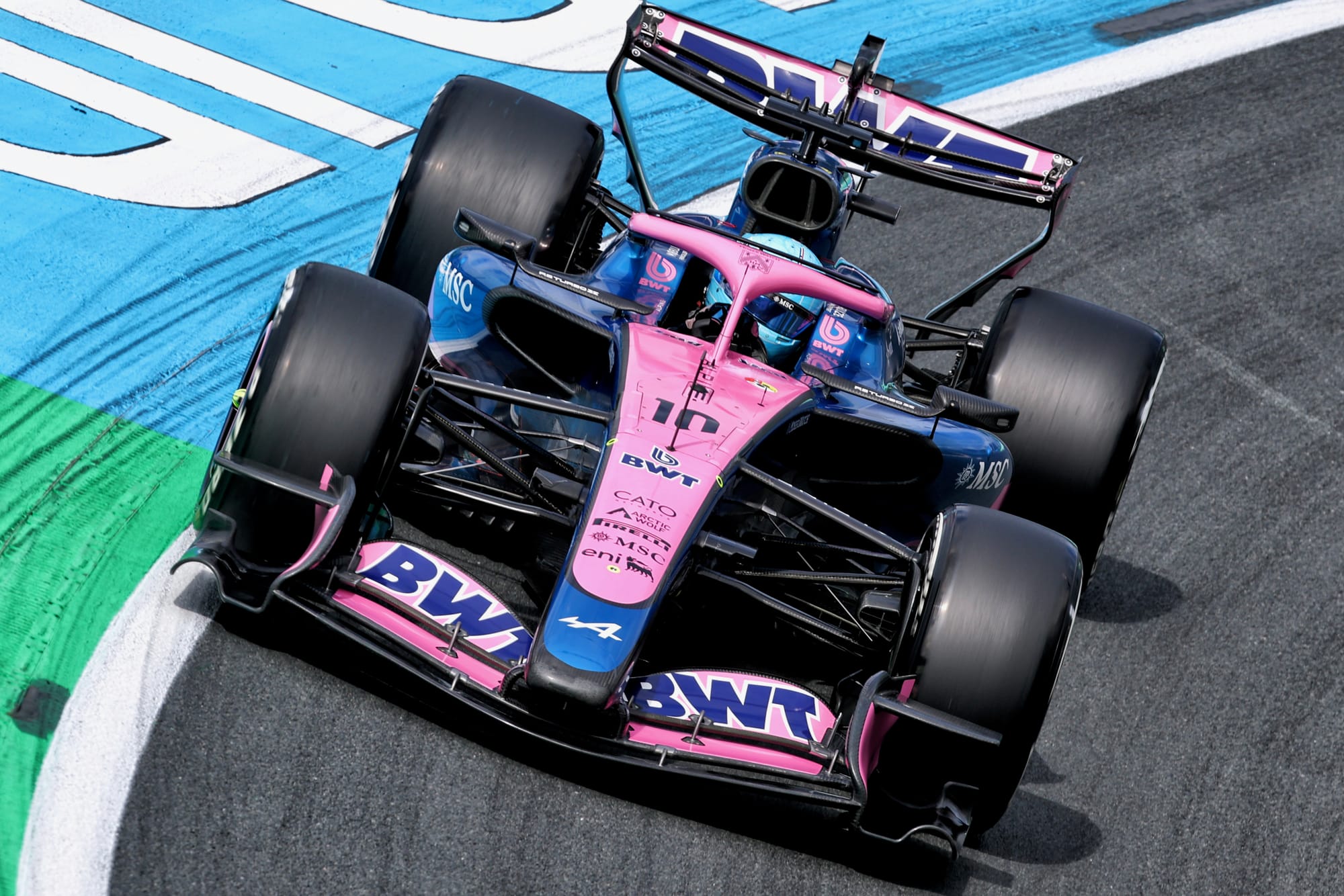
Front wing-wise, I’m not seeing any big differences. Perhaps this was updated earlier in the season and the rest of these developments are in line with optimising the revised airflow structure further rearwards.
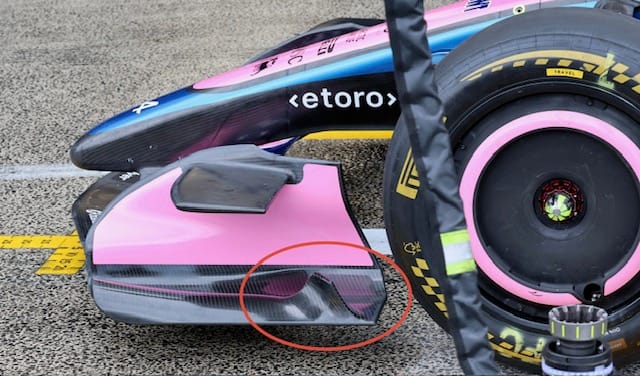
The one thing I will say about the front wing package is how neatly integrated the upper horizontal vane and the foot plate outwash vane (red ellipse on the image above) are into the actual endplate surface. Components integrated like this, as opposed to simply being a separate component bonded on, always make me happy.
The radiator intakes, as far as the opening is concerned, are now repositioned, with a slightly higher bottom profile offering more of a sidepod undercut and slightly wider.
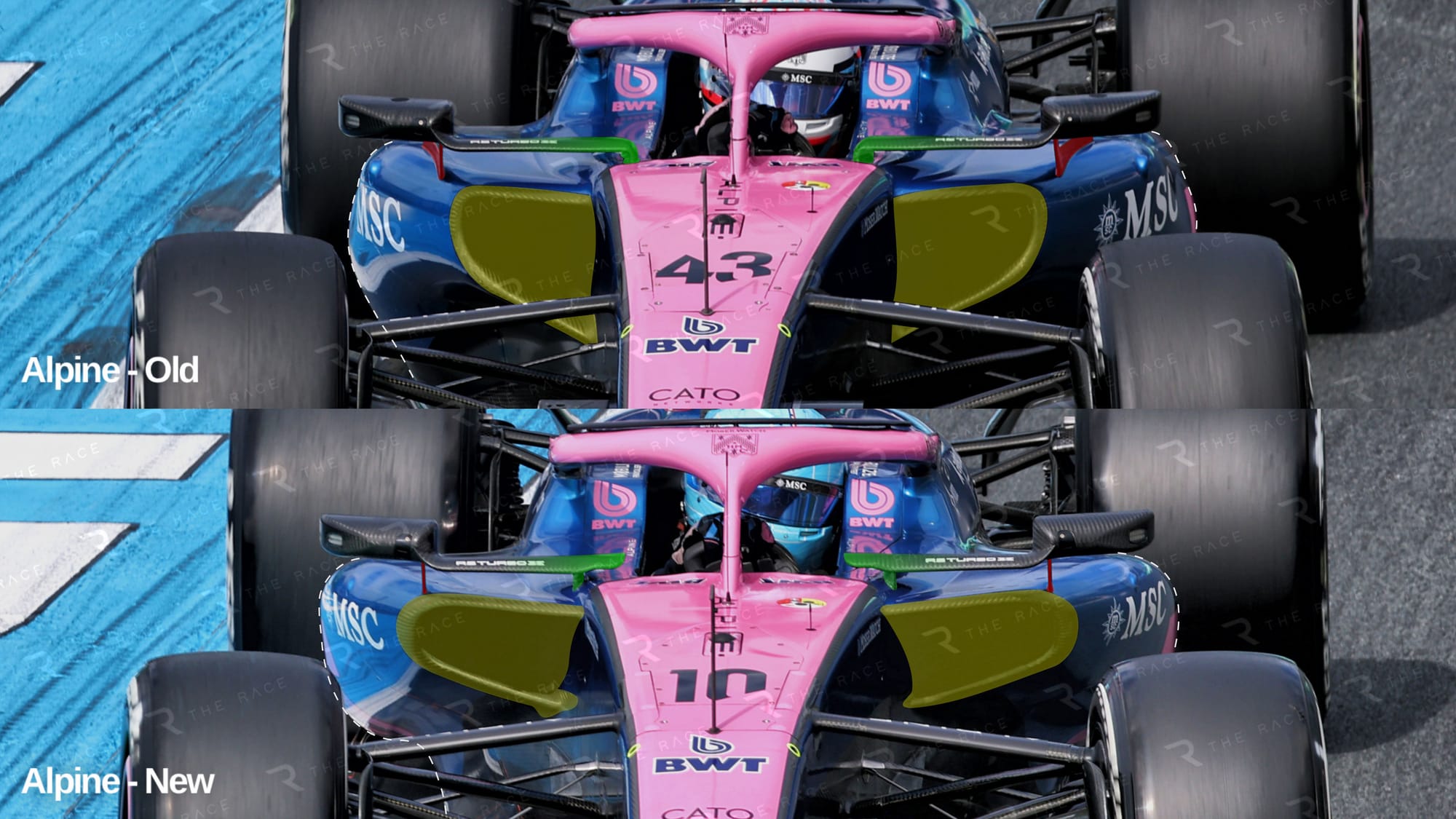
They could also be a little smaller as far as intake area is concerned. It’s the old compromise, airflow used for cooling is wasted on producing downforce so compromise is always necessary when it comes to these decisions.
The sidepod profile in side view has changed dramatically. The dotted line on the image below shows the profile change which basically puts Alpine in line with most other teams' concepts.
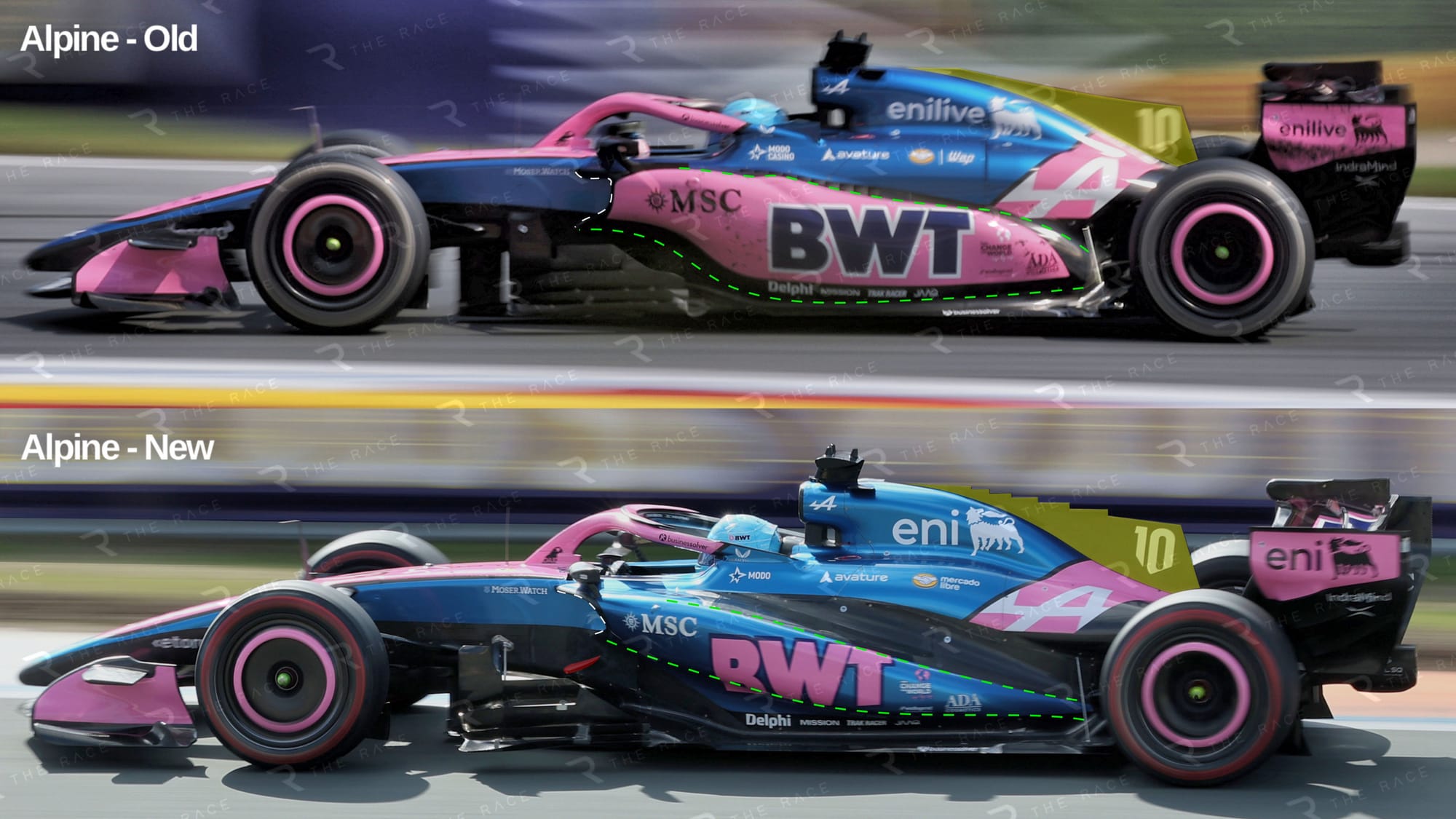
It has removed that bulbous rear section which will improve the mass flow down into the area between the inner body shrouding the gearbox and inner side wall of the rear tyre. This will improve the performance of the diffuser by allowing more airflow to pass over its upper surface.
To allow this sidepod surface change to happen, the mechanical side of the cooling under the sidepod will also been revised.
The radiator intake is now undercut, the lower leading edge of the opening being further rearward. When the car speed reaches a certain point the mass airflow presented to the radiator just doesn’t want to pass through the radiator core so it has to spill off somewhere. This positioning will allow it to flow into that sidepod undercut with more consistency.
This increased undercut will also allow the bargeboards and bargeboard footplate to be revised and to be used more powerfully. The mounting stay (cyan highlight) has been revised and is now a twin-element component acting as a flow management device turning the airflow downwards into that increased side pod undercut.
All three of the horizontal bargeboard vanes (green, magenta and yellow highlights on the image below) have been altered in side profile. They are now longer, running into that increased sidepod undercut area.
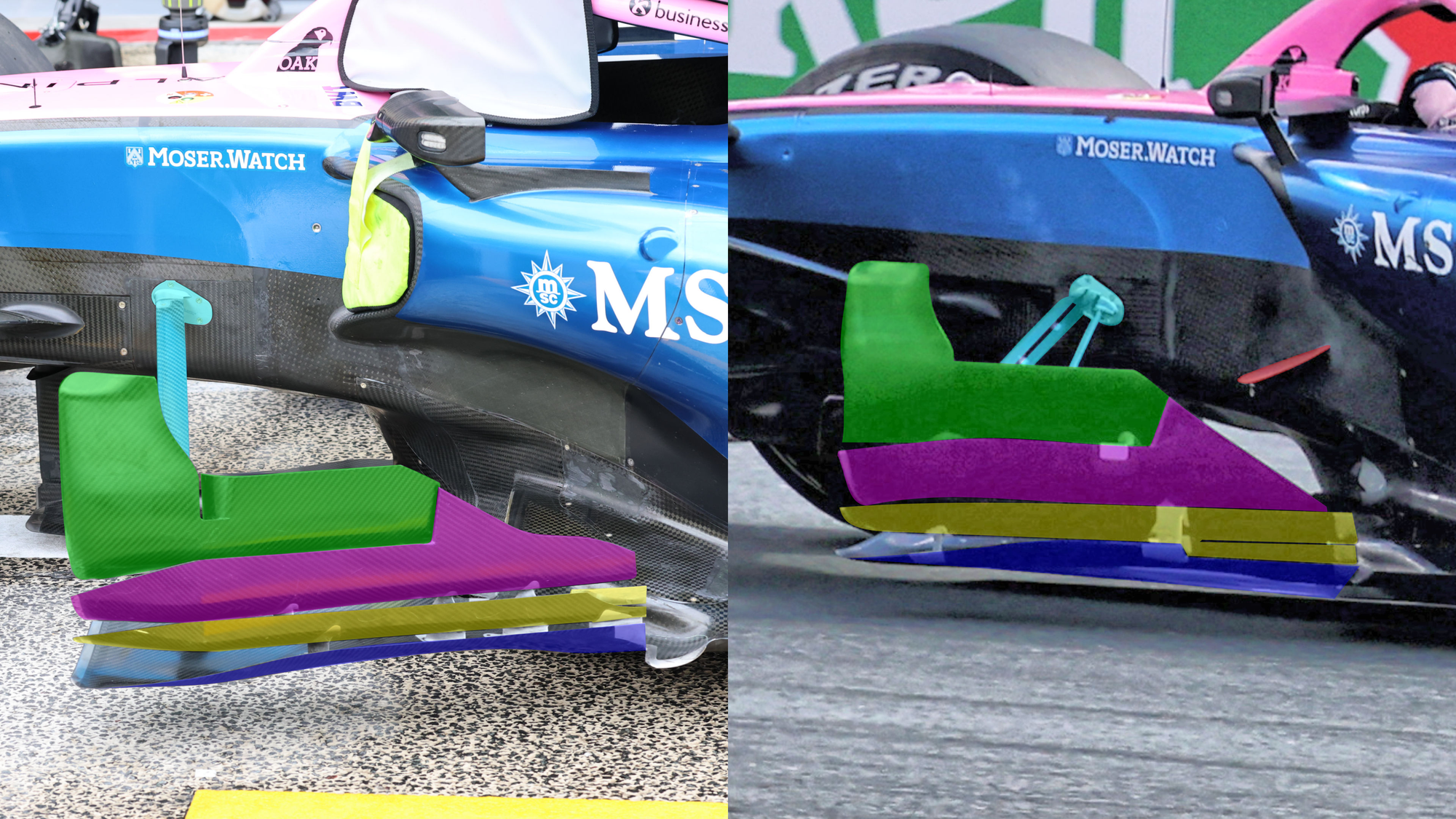
The lower one at its trailing edge (yellow highlight) has now become a two-element component. This will work the footplate outer edge turned-up section harder (blue highlight).
Getting this front corner of the floor working as its own small diffuser is beneficial for the main diffuser.
Managing the airflow here and also managing the turbulent wake behind the front tyre as efficiently as possible means that the floor outer edges can be aerodynamically ‘sealed’ better, allowing the main diffuser at the rear of the car to increase the airspeed passing under the car all the way from the leading edge of the floor. This means it will be at a lower pressure, generating more downforce.
This area in front of the rear tyres is also critical to how efficient the diffuser is. The objective here is to manage the airflow that is displaced when the rear tyre rotates onto the track surface. It has to go somewhere and if not managed as well as possible some of it will be pulled into the diffuser area, basically reducing the diffuser's volume and reducing its efficiency.
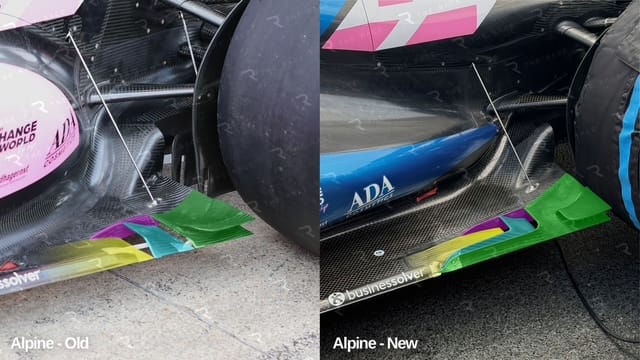
The longer side vanes (blue and green highlight) start earlier and basically allow the airflow to be turned outwards earlier too, creating higher levels of outwash or, even more importantly, reducing in-wash.
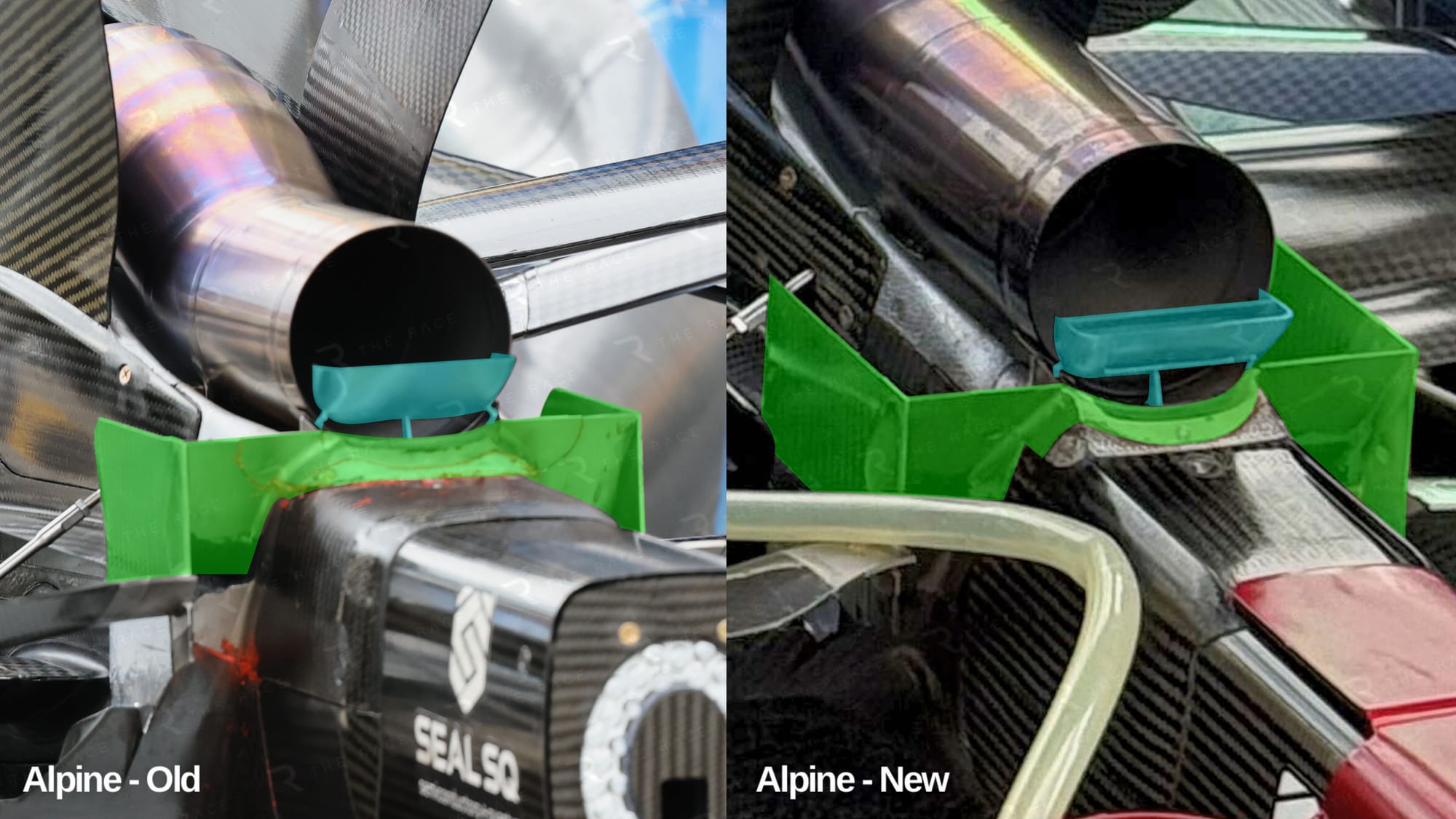
If a twin-element wing is more powerful than a single-element wing then a two-element exhaust flow turning vane (cyan highlight below) should also be better.
This exhaust flow turning vane working in conjunction with the boxed turning vane (green highlight) mounted on the crash box will improve the consistency of that central section of the diffuser, again improving the consistency of the underfloor and diffuser performance.
Will these developments mean Alpine will have succeeded in leapfrogging Racing Bulls and others that might be its closest competition?
Personally, I doubt it, as most of these developments only bring Alpine in line with what some of the other teams have had since day one. However, that’s the main challenge of a new set of regulations, who can get it right immediately and who has to play catch-up.
Catch-up is always difficult as it means you are spending twice, and all that has to come out of the budget cap, so for this year, budget cap management is probably more important than car development.
Let’s see what happens over the next few races when Alpine gets this package working as planned and on both cars.