Why another Ferrari pole bid faltered


Friday Formula 1 pacesetter Ferrari fell short of a grand prix pole position for the 18th time in 2026, this time at Austin, because of two familiar weaknesses and unfortunate timing.
Charles Leclerc and Lewis Hamilton ended up fourth and fifth but had slightly different views on why they could not match Kimi Antonelli's Mercedes and the two Red Bulls.
The tyre warm-up weakness
This year's Ferrari has battled a single-lap tyre weakness that has left it weaker on Saturdays than Sundays for much of the year.
"It's very disappointing because I think there are some other weekends where we've been strong in free practice, but then come quali, it's very clear that the others are just having a lot more in the straights, and it's very difficult for us to match that," Friday pacesetter Leclerc said.
"But I felt like it's a qualifying where we had the potential in the car, but the car also includes tyres, and in Q3, unfortunately, we were not in the right place.
"It was like 1°C or 2°C less in Q3, and for me, it was a huge difference. Just really struggled in the outlap.
"I was sliding quite a lot already from the outlap, and that made it very difficult after that."
Leclerc called on Ferrari to "work harder and try and understand those tyres very well, even better than what we are doing now, because the others I think normally have a bit more".
"It's a bit easier for them to extract the laptime in Q3 than it is for us," he said. "As soon as we are a tiny bit outside the window, we pay the price a lot. So this is something that we need to look into."
It has been a characteristic of the Ferrari throughout the year despite multiple upgrades, so that raises the question of whether it is something intrinsic to the car philosophy that can't be fixed until 2027.
"No, I wouldn't say that, but it's maybe a bit of a compromise that you would have to choose between race and qualifying," Leclerc said when The Race put that theory to him.
The same weakness that leaves it struggling to keep its tyres in the right window in qualifying is a tyre preservation strength in the races.
It's why Leclerc expected things to be better on Sunday, as was the case at races such as Spa, where Leclerc and Hamilton finished second and fourth after qualifying fifth and sixth.
As for Hamilton, he didn't feel tyre temperature was an issue. "I had a really good out lap, so no problems for me. The car felt good, it was a clean lap. No issues at all, really," he said.
Instead, he zeroed in on Ferrari's main weakness as the cause of the deficit.
The power deficit
Ferrari's single-biggest weakness in 2026 has been its power unit and that cost it once again at Austin, in particular down the long back straight.
Hamilton was caught off guard by qualifying fifth and after being informed of his position, he told his race engineer Carlo Santi: "These guys must be turning it up for that last Q3, because where did that time go?"
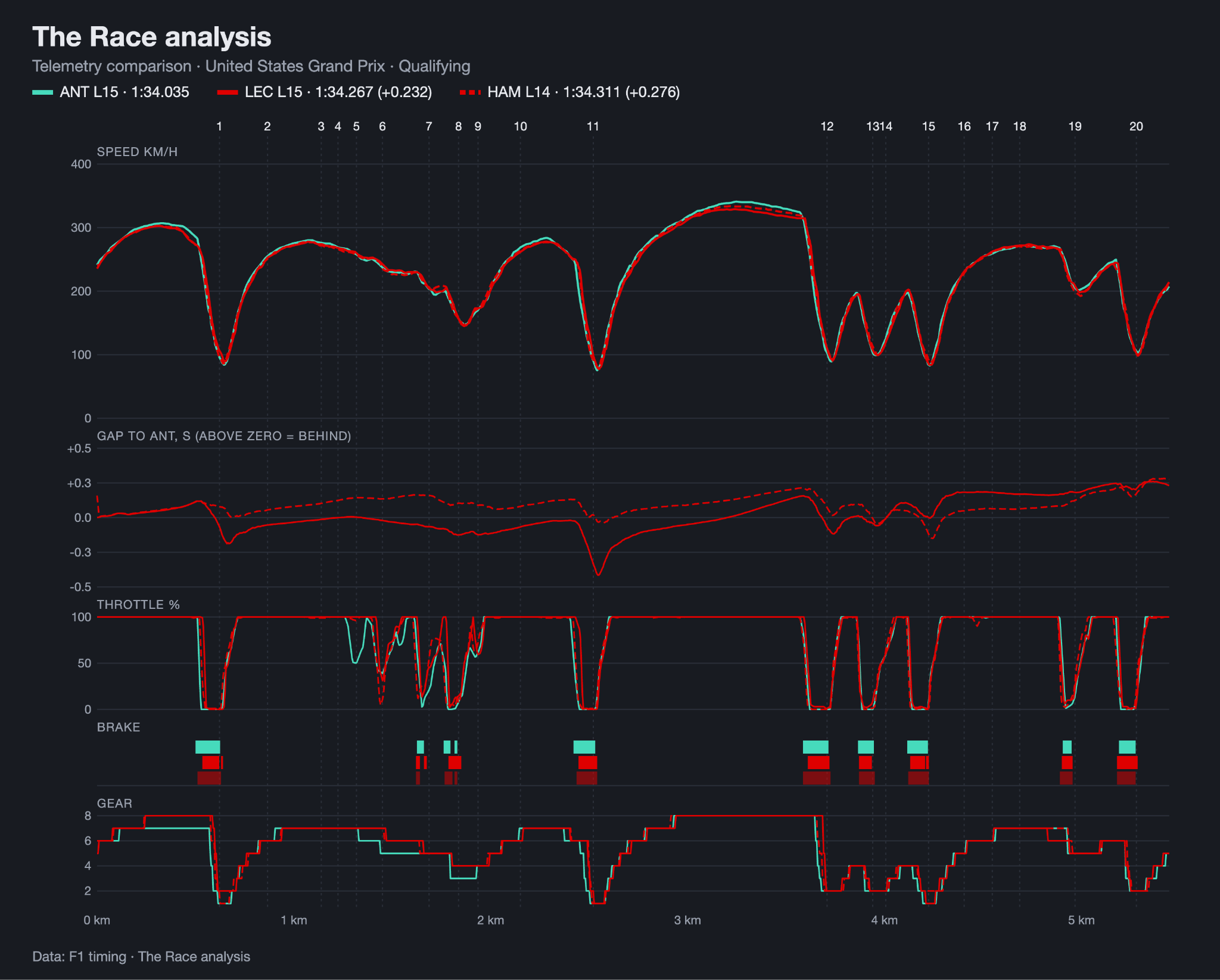
But the data did not show much evidence of that as Ferrari's straightline deficit is consistent throughout all three stages of qualifying. Leclerc is actually 5km/h down on Hamilton at the end of the back straight, and 10km/h down on Antonelli.
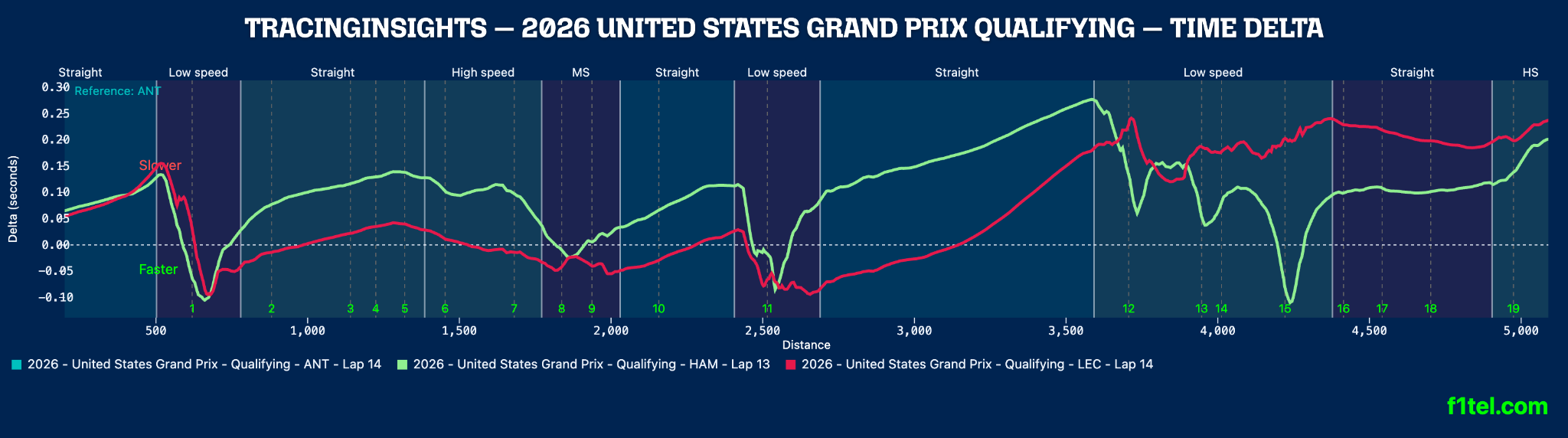
Hamilton (green line) is almost a tenth up on Antonelli (baseline) as they reach the back straight - in fact Hamilton and Leclerc are a net 1-2 at that snapshot in time - but by the time they're at the end of it Hamilton slipped as far as two tenths back.
"Our car is really solid, maybe slightly better than the others," Hamilton said.
"But I think they have closed up on chassis. We've seen the Red Bull close up on their downforce. Mercedes took a three-tenths step of upgrade, at least. I think they're starting to figure out how to utilise that.
"So they're now matching us through the corners. We're not able to take that step in this season to close that speed on the straight."
Asked about the comparative straightline speed of the Red Bull, Hamilton said: "Some places it's three to five tenths. Maybe it's four tenths. It's pretty impressive. I don't know if you've seen the overlays - Into Turn 1, ours starts dipping and theirs just keeps going.
"So that's hard to compete with. If we had the same power as them, we would be right there in the battle. I think we could probably be on the front row.
"But we know that's the case, so we try to make the most of it."
Some of Hamilton's 0.276s deficit was briefly reclaimed, but Hamilton ended up making a small error out of the final corner that cost him the chance of beating Leclerc and potentially even splitting the Red Bulls.
Unfortunate timing?
Leclerc's Q3 lap was actually slower than his best Q2 effort, which, if repeated, would have put him on the front row alongside Kimi Antonelli.
Leclerc and Hamilton were actually the only two drivers to legally improve on their Q3 run with laptimes better than anyone else's final efforts. Unfortunately for Ferrari, Antonelli and the Red Bulls had set better laps on their first Q3 runs.
Final Q3 lap order
Leclerc: 1m34.267s
Hamilton: 1m34.311s
Hadjar: 1m34.363s (track limits deleted)
Norris: 1m34.379s (track limits deleted)
Verstappen: 1m34.482s (track limits deleted)
Russell: 1m34.552s
Piastri: 1m34.805s
Antonelli bailed out of his lap
It does appear the Ferraris set their fastest Q3 laps when the track conditions looked less favourable compared to the Mercedes/Red Bulls, with gustier winds and more cloud cover later in the session.
Ultimately, it may have paid the price for not executing as well on what turned out to be crucial first Q3 runs, where it was fourth and sixth.