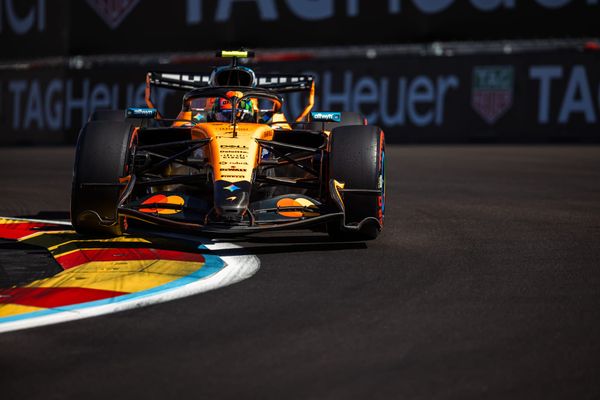
When a young Ayrton Senna drove F1's elite crazy

Supreme car control and a devastating turn of speed were two qualities that marked Ayrton Senna out as a future champion on his path to Formula 1 and during his rookie season with the Toleman team.
But it was after his first F1 move, to Team Lotus, that Senna also made his mark on F1 as he routinely left his (significantly more established) rivals disgruntled.
That's a story that Edd Straw and Mark Hughes dig into for the second episode of F1 Rewind, the new F1 history podcast from The Race, which revisits some of the biggest tales from grand prix racing (and the drivers and teams involved in them) with a fresh perspective and angles that weren't necessarily available at the time.
Senna's Lotus years were, in effect, an apprenticeship before his ultra-successful McLaren move - and a last hurrah for a Lotus team that was beginning to unravel - where he became a proper thorn in the side of the F1 elite.
A young man in a hurry
The driver who would go on to become a three-time world champion caught the eye before and during his title-winning British Formula 3 campaign in 1983; Ron Dennis had offered to pay for Senna's F3 campaign if he committed to McLaren long-term, and during that season he tested for Williams (which had no space for 1984) and Brabham.
Senna wanted control of his own destiny above all else, though, and so the decision was to pick Toleman - on a three-year deal, with a relatively modest release clause of around £100,000 - for that first step.
Senna, of course, turned heads in his rookie season; outstandingly with his runner-up finish in the red-flagged Monaco race, but also with podiums at Brands Hatch and Estoril.
And so really the Toleman deal just deferred his arrival at Lotus, another team that had showed interest for his F1 debut, until 1985. There was no problem with that, per se; Senna had signed the contract, and Lotus had met the threshold for the release clause.
The problem was that Senna hadn't told Toleman before his move was announced - even if that did demonstrate, as Straw says, "how proactive Senna is being" and how already he was "very deliberately avoiding being under the control" of any team.
Hughes - one of those who saw Senna during his F3 campaign - picks up the story.
"[Senna was] absolutely ruthlessly strategic in his planning of his career," he says. "You saw it in his junior career as well.
"He wanted that independence. He was quite prepared to do what was necessary to get in the most competitive machinery that he could at that moment."
Straw adds: "He was very much involved in the contracts and the detail. And even at this time, there's stories of him being quite pernickety in terms of those contract negotiations and the detail. He wasn't just signing it and off he goes; he really was on top of things.
"And I think that's one of the qualities Senna had, even at this time in his career. He knew he needed to be at Lotus. And he was prepared for there to be a little bit of a mess."
Senna the disruptor
As suggested, this only really ever put Senna's movements - which he'd often already calculated, something we'll come back to later - on hold for a year.
Toleman did bench him for the antepenultimate round of the 1984 season at Monza, something that probably taught Senna a lesson for not following the right sequence of events in telling Toleman before his move was announced.
But he joined Lotus as a driver with a very big reputation - one he lived up to. Perhaps not instantly, as he was outqualified by team-mate Elio de Angelis at the season-opening Brazilian GP (his home race), but Senna claimed his first grand prix win on only his second start for Lotus, and it was arguably the best of his 41 victories.
"He thought so," says Hughes. "He thought that was the greatest of all his grand prix wins.
"Dominant pole. Start to finish in the wet, in the lead. Fastest lap by, what, three-quarters of a second? Something like that, totally dominant. He was a minute clear of second place. Just an extraordinary demonstration of just who he was. That's the level of driver that you're dealing with.
"And that's when, I suppose, you could say it was properly apparent this wasn't just [Senna] punching above his weight in a less than fully competitive car, which he'd been doing in '84. This was, 'OK, here's a car that is capable of winning. Watch this'. And yeah, extraordinary."
The Lotus 97T of 1985 was undoubtedly more competitive than the Toleman he'd driven the year earlier, but it wasn't as good as Senna was making it look. (This was, after all, a car that was very similar aerodynamically to what Lotus had campaigned in 1983, and hadn't changed all that much by the time of his final season with the team in 1987 either.)
And that meant to be competitive, Senna had to box smart - but that also meant ruffling the feathers of the established drivers around him, starting with team-mate de Angelis but extending much further.
"The thing I really like about this season, '85 in particular with Senna, is the extent to which he annoys everyone," says Straw. "It's the classic thing with a young driver.
"In Rio testing, he has a collision with [Nigel] Mansell because they have a bit of an annoyance in the morning on the Monday of a Rio test and Mansell's on a race run and didn't want to spoil his numbers, so Senna gets irritated. Then they have a collision late in the day.
"And then you've got, at Imola, [Alain] Prost - that was the third race - criticises 'F3 driving tactics' from Senna.
"[In Monaco, Michele] Alboreto forces him up an escape road in retaliation in qualifying. Because Senna actually got told by [Lotus team manager] Peter Warr to get in Alboreto's way as well, which was probably the start of actually the Senna-Peter Warr relationship, [which] didn't go particularly well.
"Senna and Warr didn't entirely see eye to eye; Senna was sort of calling the shots, whereas Warr was this kind of military background. He'd been to Sandhurst. So he was very much a kind of chain of command [character], 'what I say, goes'.
"And actually this gradually kind of unravels through the time at Lotus when Senna sort of starts calling the shots."
Senna was not the absolute first to do it this way, but he was in a sense the prototype for the modern-day young driver in a hurry, and the shift away from long apprenticeships - even if his Lotus spell did last for three years.
"It's a driver who comes in, knows that they're good enough and is really not prepared to hang back and wait," says Straw. "It's like, 'No, I'm going to be number one. I'm going to make decisions. I'm going to get myself into the best team'."
"The really special ones can come in at a level where they can compete at the front, pretty much straight away. Not necessarily fully rounded, but can compete," says Hughes.
Straw adds: "But I do just love this spell of annoying all the established top drivers, which [Max] Verstappen did, which Michael Schumacher did - he annoyed Senna, didn't he? So you start to see that happening more and more.
"And I think because Senna was so influential as a driver, the legend of Senna endures to this day. I think drivers are almost more conscious of the need to be a massive pain in the neck straight away [because of the impact Senna made]."
The first McLaren machinations
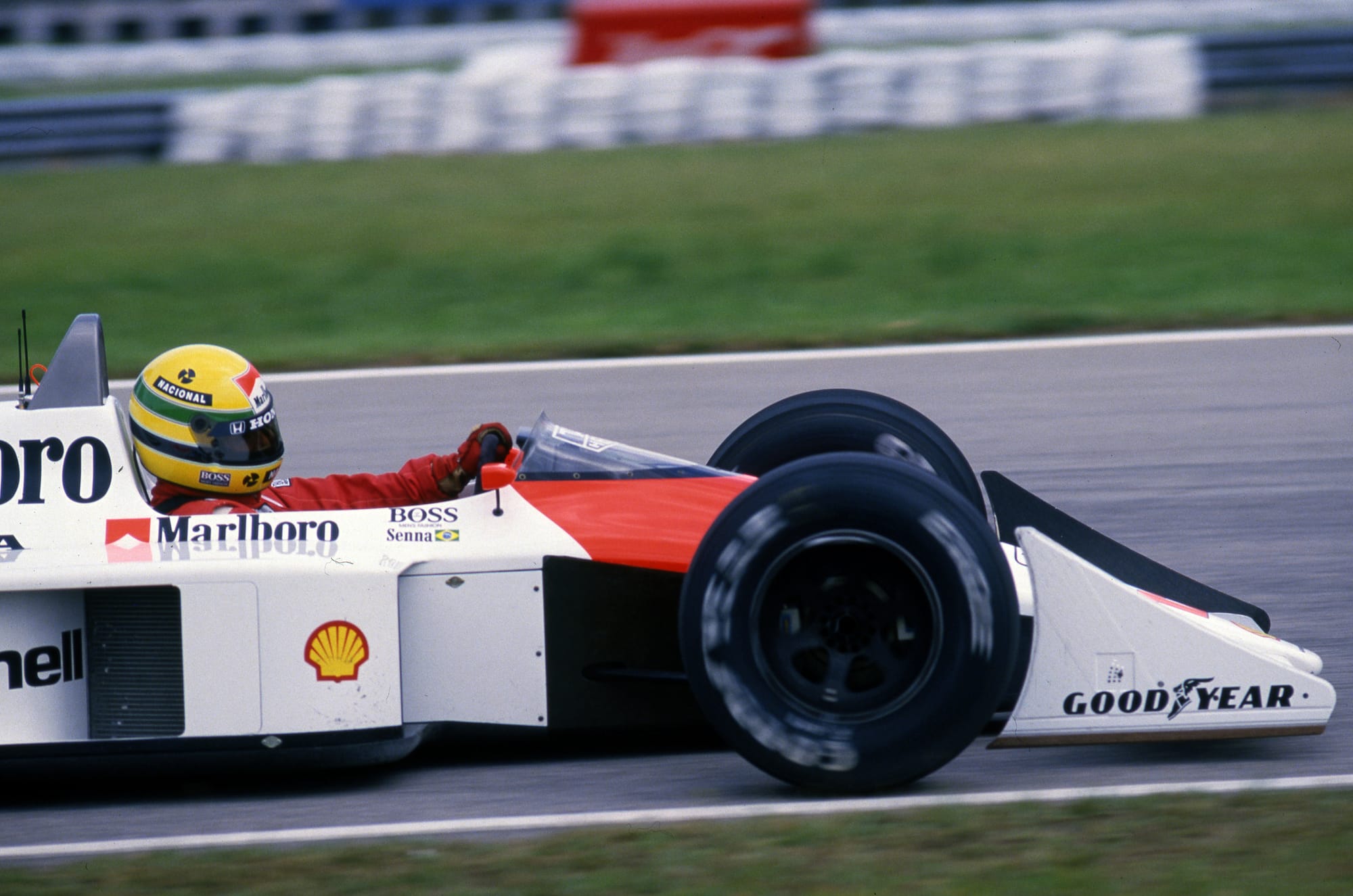
The statistics from Senna's Lotus spell are impressive: seven poles, two wins, and four further podiums from his first year; and six wins in total across his three-year spell with the team.
The fact that ran into a third year was something of a surprise, as Senna elected to stay with the team on a new two-year deal.
But there was a calculation behind that: that two-year deal included a break clause that allowed either side, team or driver, to get out of it regardless of the situation. And Senna, the operator that he was, had started his machinations towards a McLaren seat for 1988.
Honda was in the picture with McLaren for that season, and Senna had instigated the first meeting with Honda - as early as the Monaco GP in 1986 - for Lotus to take its engines for 1987, thus creating a route to McLaren for the following year.
"It [the break clause] was before a date in early August. So obviously Lotus wouldn't have signed that if they didn't have to," says Straw. "But that tells you the power Senna has got in the driver market, and he's not afraid to use it.
"[There's] that undercurrent of [Senna being] in a hurry, a bit of frustration. He wasn't delighted with where Lotus was. But obviously realising the value of that extra year with Lotus, because Honda's coming on board and it's all part of the masterplan."
Edd and Mark analysed all of that in depth in the full second episode of F1 Rewind, so make sure you listen to it here.