What I learned escaping the F1 bubble
Nearly a decade in a bubble is a long time. Others have done plenty longer but a ninth consecutive season travelling to or working nearly 200 races means Formula 1 has dominated a huge part of my life.
For better and worse, following F1 inside the paddock is not the same as watching from afar. It is both an immense privilege and quite a burden, depending on circumstance - and an increasingly curated method of studying F1 for the information I have needed to do my job gave me a very narrow lens to view it through, too.
It has been a long time since I watched an F1 race to enjoy it, or followed a weekend without poring over thousands of words of quotes and hours of data or onboard footage. Though the F1 media talks to, and sometimes on behalf of, fans an awful lot, we rarely have the same perspective. Again, for better and worse.
This summer was different. I stepped away for three months on paternity leave to focus on my three-year-old son and my daughter, who was born last September, and in doing so escaped the bubble that had dictated so much of my time for so long.
With seven races taking place in this period, a very early thought I had was: how much will I still care about F1 if I don't have to? Especially in the middle of a season that, thanks to the new rules, has tested my patience professionally and personally more than once.
F1 should phase out Thursdays again
One of the very first things I noticed was something I didn't notice happening.
The day before cars even hit the track, F1's circus is already in full swing. Media day is such a big deal in the paddock, and I know there are fans who are very aware it's a thing and do know to look out for quotes or even follow driver press conferences.
It is a colossal operation to feed a content machine that is bigger and hungrier than it's ever been. All the drivers speak to various broadcasters and the written media, there's a couple of team people that speak too, teams are doing their own content production. It's incredibly vast.
I get that there is interest in it, and I'm not knocking that. But I have often thought it feels like a bit of a waste.
There's very little shelf life for what preview content is picked up and often in double-headers and triple-headers (which are so common these days) we have typically heard from all these people a few days ago. F1 did try to phase this day out a few years ago, and I think the principle was right even if the way it was trialled didn't work.
I've often wondered - given we can see in our own analytics that there isn't any major uptick in attention on a Thursday - how much this is a self-serving exercise that has ballooned into a massive part of F1's footprint without actually having the value to merit it. And I was surprised how early on it was that the Thursdays just completely passed me by once I was not there.
There were at least a couple of occasions where it was only seeing that there had been a practice session on Friday that I remembered 'it's race X this weekend'. I know that's heavily influenced by my own circumstances, but that is the point: it was the single-biggest shift for me from a day that took up a huge amount of time and energy to one that did not even register.
And I wonder how many fans that goes for.
A sprint benefit I did not expect
Two of the race weekends I watched from the fan position were sprint events. These actually have a slightly stranger function than I thought they would.
On normal weekends it was difficult to really engage fully with three practice sessions to labour through (and Friday just not being possible to follow in the moment). As I said, I didn't even notice some of them starting!
That meant I'd watch qualifying with quite a big knowledge deficit compared to what was possible - and I felt that sometimes. It also inevitably carries over into the race, and not in a good way. It's not, 'Ooh, I don't know what's going to happen' it's, 'Oh, things are happening and I'm not really comprehending it'.
But I found the sprint weekends surprisingly good for quick-fire catch-ups of what's going on, without really feeling like I had my comprehension of the weekend dragged down. They were an easier and better experience to follow casually, whether that was a Friday evening where the daytime action has been missed and it's simply to have a quick catch-up with sprint qualifying, or finding the time to watch the sprint at some point on the Saturday.
So the sprints, actually, I enjoyed a lot more than I thought - even though the races are what they are.
I've long been accepting of F1's primary argument that the sprint weekend makes for two better like-for-like viewing events. Sprint qualifying is better than an FP2, the sprint race is better than FP3. That doesn't change the fact I think the races usually aren't good, and I would like F1 to do more with the sprint format overall - this was also emphatically reinforced by sitting through the sprints at home.
Tired of the propaganda
This is old news now, because the comments were made a while ago as I write this, but the messaging from F1 and Stefano Domenicali when it comes to what fans supposedly want was a grating experience from a distance. Especially as it wasn't the first time that's happened this year.
We are all familiar now with Domenicali feeling the need to confront any challenge to F1's product quite combatively. Even against the uncomfortable reality that the 2026 rules have been an extremely bad compromise and many changes are coming next year, after extensive deliberation, to address the issues that supposedly don't exist.
I'd like to think it just comes out the wrong way, and worse than intended, but I can see why so many fans feel like the propaganda flirts with borderline contempt for 'traditional' fans because of supposed metrics and the apparently very important testimony from George Lucas that, actually, new fans love this version of F1 and they don't care about technical information or the nuance of a driver's racecraft.
Personally, I believe that's wrongly dismissive of fans who do value such wonderful elements of grand prix racing - and I think it sells newer fans short, because we have come across plenty who got into F1 watching Drive to Survive, for example, and swiftly wanted deeper coverage.
It blended poorly with another thing I saw that exemplified the hyperbole that engulfs some aspects of modern F1: the teaser of something dropping during the summer break, which just turned out to be promotional material that had no depth or substance whatsoever.
That would annoy me in a professional capacity but seeing it casually as a fan it felt ill-judged at best: I don't think this is the year to be hyping up something that doesn't live up to expectations.
Hope for 2027
A hill I am happy to die on with the 2026 rules is there are elements of the racing that are actually good. They're just clouded by problematic extremities.
Having initially championed my position from the luxury of watching trackside and seeing how the new cars moved around (even if that was still to the displeasure of drivers including Max Verstappen) I have now seen the best and worst of this ruleset from afar.
Monza was a great deal better than I feared, and it remains the case that cars can follow closely on a range of tracks even though proper overtaking can be hard to come by - if I never see a lap of the 2026 Madring race again, I'll be a happy man.
What disappointed me a few times was just how hard it was to follow who's doing well and who isn't. When you're working the weekend and in the middle of it all, there is a drip feed of information and a picture starts to form almost just by being there - so then when things happen in the race, there's usually some morsel of context or understanding that helps put it into context.
But I saw so much of what felt like first-lap randomness with battery usage, and cars rising up or falling back, without really being sure if these people were doing a good job or a bad job. Is it algorithm-dependent? Are the drivers more passive participants in crucial moments than ever before?
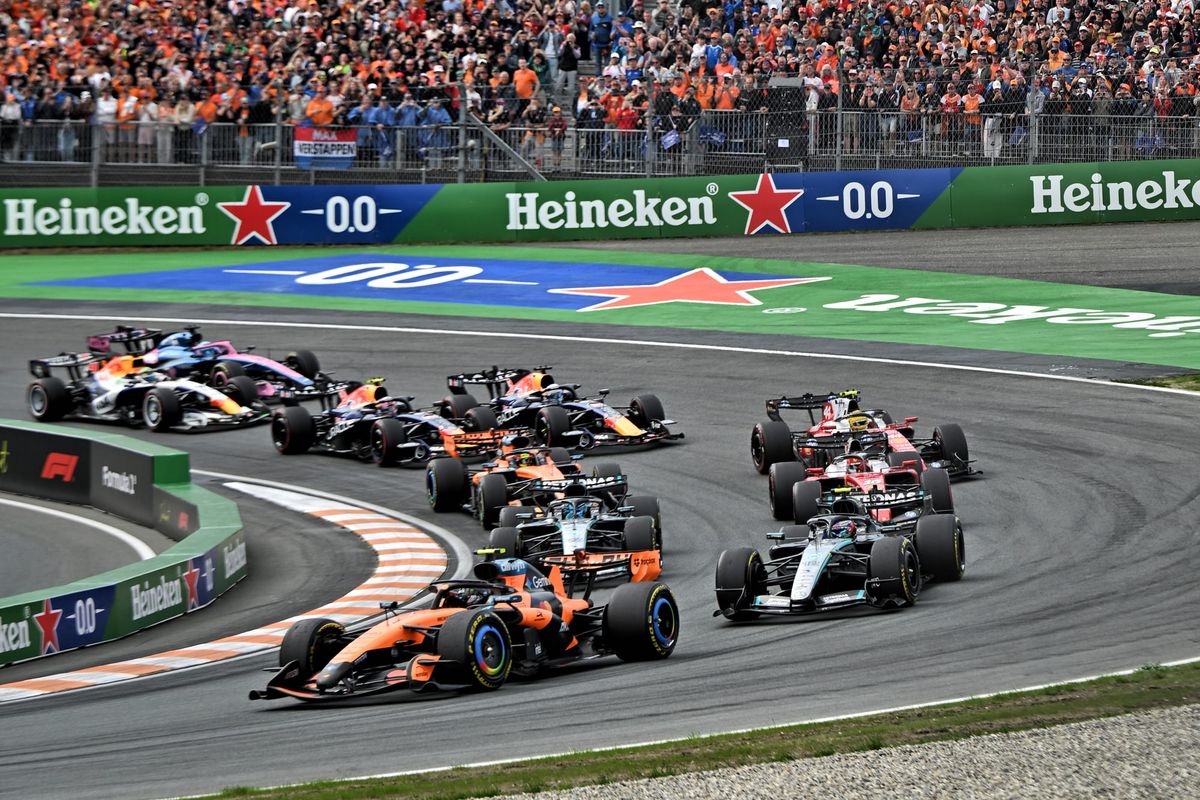
I found it really frustrating to almost struggle to see the sport in this sometimes. So it really resonated at Zandvoort, where Verstappen talked about F1 being too easy in that regard.
Still, I am curious and optimistic about what will change in 2027. I was not being glib when I wrote at the top that I was curious to discover what my relationship would be with F1 when it was more casual - I wanted to know if I still cared. And I think the biggest takeaway for me is I still do.
I was a bit worried that I wouldn't like it anymore, or my interest would fade when I wasn't obliged. It was never the number-one priority for me - that was the whole point of taking time away! - and I admitted I tuned out of one or two races out of boredom a couple of times.
But the enthusiasm for F1 is still very much there. And it is perhaps now underpinned by a slightly different perspective beyond just the one gleaned from the privileged position I had for so long.