What Alpine got right at Monza and everyone else got wrong
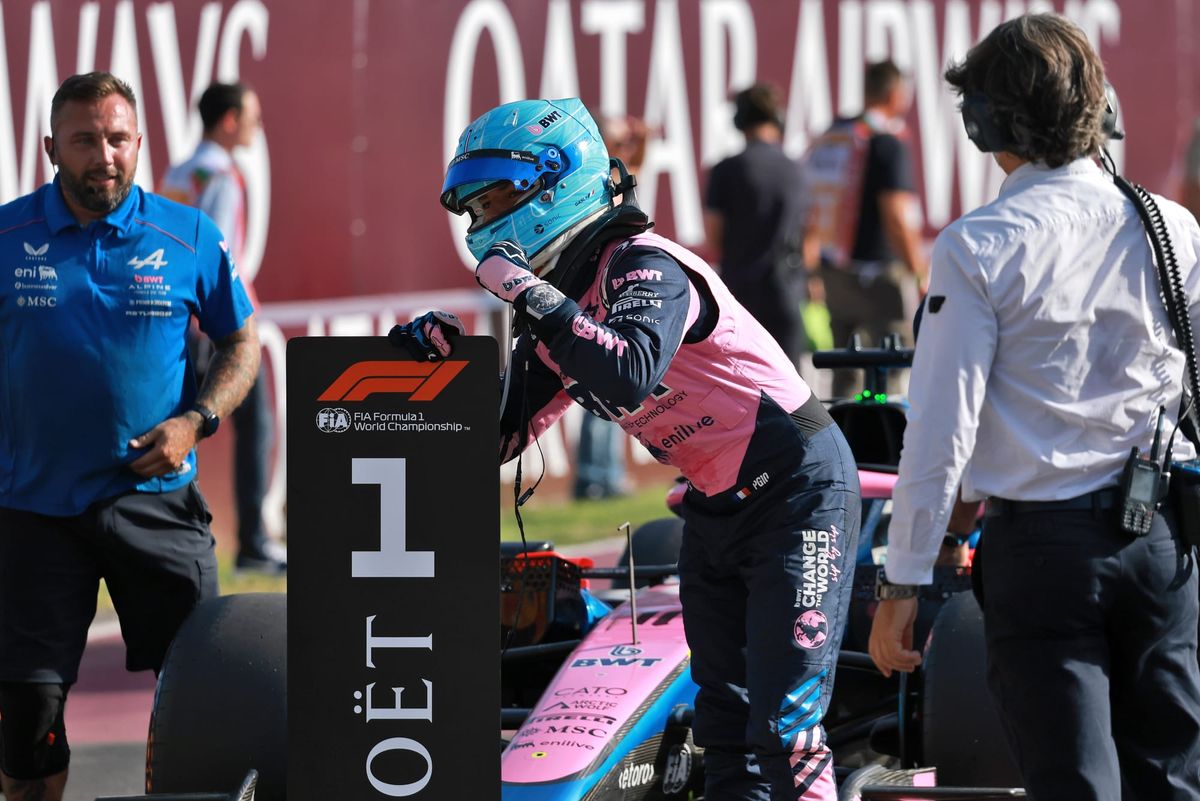
The car that's currently sixth in the Formula 1 constructors' championship just took pole position in a straight fight in a dry qualifying session at the Italian Grand Prix.
F1 is used to freak underdog poles in mixed weather, but Pierre Gasly and Alpine's Monza achievement was something very different.
You have to go back to Pastor Maldonado's 2012 Spanish GP pole for Williams (then seventh in the championship) for an equivalent - and even that only happened because Lewis Hamilton's pole-winning McLaren was excluded from qualifying. Which means perhaps the real equivalent is Giancarlo Fisichella's 2009 Belgium pole for Force India (which was on zero points for the season before that race).
So how on earth did it happen?
The answer is really a 50/50 split between things Alpine got right and things the teams that should've beaten it got wrong.
What cost the favourite pole
Mercedes, and more specifically George Russell given team-mate Kimi Antonelli had a sizeable grid penalty, went into qualifying as the clear favourite, with most of Mercedes' rivals expecting Russell to emerge with pole position.
And it was heading that way after the first Q3 run, with Russell on provisional pole, via a small tow assist on the start/finish straight from Antonelli, who had already made it clear he'd sacrifice his Q3 to help Russell.
But everything went wrong in the preparation for the crucial final lap. Russell was running on track behind Antonelli, however, Antonelli encountered a slowing Max Verstappen at Parabolica and had to back up into Russell, who also had to slow just before opening his flying lap.
Antonelli towed Russell on the start/finish straight, then jumped out of the way before the first chicane, leaving Russell to pick up a tow from Verstappen, albeit closer to him than he'd have liked. Russell called it a "bit of a mess".
He still improved his laptime on his final run, but he ended up 0.060s behind Gasly - time he likely lost with the sub-optimal preparation. Plus, Russell struggled with his brakes locking like many drivers at Monza.
Russell admitted "It was a very scrappy session" and said the car didn't feel as good as it did in final practice.
It was undoubtedly still a car good enough to secure pole position. Put together Russell's three best sectors and his ideal lap is a 1m21.633s, 0.233s faster than his qualifying lap and 0.155s ahead of Gasly's pole lap.
Gasly in contrast put all of his three best sectors together on his final run. - Josh Suttill
Ferrari botched it but got away with it
Hamilton made it fairly clear after qualifying that he felt Ferrari should have been much more coordinated in how it choreographed its two cars.
If you contrast how smoothly Alpine ran throughout the three segments, getting Gasly at or near the top of the timesheet from Q1 right through to Q3, with Ferrari's relatively yo-yo performance, you can understand why Hamilton was so frustrated afterwards.
But for Gabriel Bortoleto's Audi oversteering through the middle of the Ascari chicane at the end of Q2, Hamilton wouldn't have even made Q3, and the higher risks taken by Ferrari (and McLaren for that matter) in trying to work both cars towards the front of the grid were more exposed to the ‘essentially sacrifice one car' approaches taken by Alpine, Mercedes and Red Bull.
And the fact Ferrari, even with its updated ADUO 2 engine, still carried a 10-20km/h deficit through every speed trap, suggested properly executed towing and clean laps were even more valuable to Hamilton's and Charles Leclerc's chances.
Considering how close Ferrari came to disaster in Q2, to then have both its cars ultimately (and fortuitously) starting on the second row of the grid is a fantastic outcome from such a messy session. - Ben Anderson
McLaren's poor execution
Monza was never expected to be McLaren territory, but the underlying pace of the MCL40 in qualifying trim was stronger than expected - certainly far better than its final grid positions of sixth (Oscar Piastri) and eighth (Lando Norris).
"It would be a little bit of a red herring, or an excuse, to say 'oh we have too much drag," said team principal Andrea Stella of the role the car's aero efficiency weakness played. Instead, he pointed firmly in the direction of execution for McLaren's underachievement when it should have been "in the mix for the first couple of rows".
Hidden beneath a solid second and third in Q2 was the first key mistake. Piastri joined the track for his first run at the point where an out-of-synch Liam Lawson was on a quick lap, leading to him impeding the Red Bull in the chicane. A three-place grid penalty was the result, which puts Piastri sixth for tomorrow's race.
In Q3, there were myriad problems. McLaren struggled to position its cars ideally for a slipstream, which was partly owing to its position in the pitlane. This meant Norris didn't have a good slipstream on his first run in Q3. The McLarens were then at the front of the pack for the second run, with Piastri ahead, but when he locked up and cut the first chicane it not only hindered Norris but cost him his tow. Although Norris did improve on that run, it wasn't by anything like it should have been.
That lock-up from Piastri was a consequence of not optimising the outlaps by dealing well with the 4MJ harvest limit that makes it difficult to get temperature into everything before the start of a push lap. On top of that, Stella admitted that "we had some issues managing the battery, and here in Monza every 1% in the battery charge costs you a significant amount of milliseconds". - Edd Straw
Red Bull had its own problems
In a way Red Bull made the biggest contribution to Alpine's pole given how much Verstappen's positioning affected the lap with which Russell really should've beaten Gasly.
And Red Bull should have been well placed to pull off some intra-team slipstreaming choreography given Lawson's grid penalties meant his own performance could be pretty much sacrificed to boost Verstappen.
Only if Lawson got to Q3, though. And thanks in large part (but not solely due) to Piastri baulking him in Q2 just as he was being given a reciprocal tow by Verstappen, Lawson wasn't actually there to play the team game when it was needed.
But Verstappen didn't think any of that mattered as much as the unspecified component failure that meant his Red Bull wasn't running at the right ride height for his Q3 runs.
"With how the car was responding in FP3, I didn't think I was fighting for pole, but it was quite a comfortable car to drive for once, and that was actually really nice," said Verstappen, "but unfortunately then we picked up another problem in qualifying."
Which was the diplomatic translation of his "this car is made of paper" radio rant after qualifying only sixth. - Matt Beer
What Alpine got right
It is fair to say that Alpine was as surprised as its rivals about a pole position that it had never even dreamed of before the Italian Grand Prix weekend.
As it tried to piece together the answers on Saturday night as to how it had done it, it became clear that, as much as the big teams had all slipped up in their own ways, Alpine had equally got itself into the perfect position to capitalise by getting everything within its control spot on.
Having a Mercedes engine around Monza certainly helped, as it remains the benchmark power unit.
But one of Alpine's weaknesses earlier in the year – of not enough downforce – may well also have become a strength at Monza because of the low drag benefit.
The A526 appears to be very efficient with good top speed, so that helped lift it into contention.
The upgrades Gasly first got for Zandvoort have also served to give the car a better balance, and throughout practice Alpine had evolved the set-up to get him into a place he was very happy with.
That allowed him to attack the corners under braking (where others were struggling a lot) and take things to the edge through Ascari and Parabolica.
Perhaps most critical of all though was Gasly's perfect slipstream positioning in the train of cars.
Alpine had confidence to drop to the back of the pack in that final run – as that offered the biggest tow gain.
That is not without risk, because there is a threat of slow traffic ahead meaning you don't get across the line in time (Gasly and Franco Colapinto made it with around 10 seconds to spare), plus a danger of anyone ahead going off and bringing out yellow flags that derail everything.
Despite a couple of cars going down the escape road at Turn 1, Gasly had a clear run and a beautiful slipstream from Hamilton ahead to secure himself the six-hundredths of a second edge that gave him the top spot over Russell. - Jon Noble