Farewell to the worst car of F1 2026
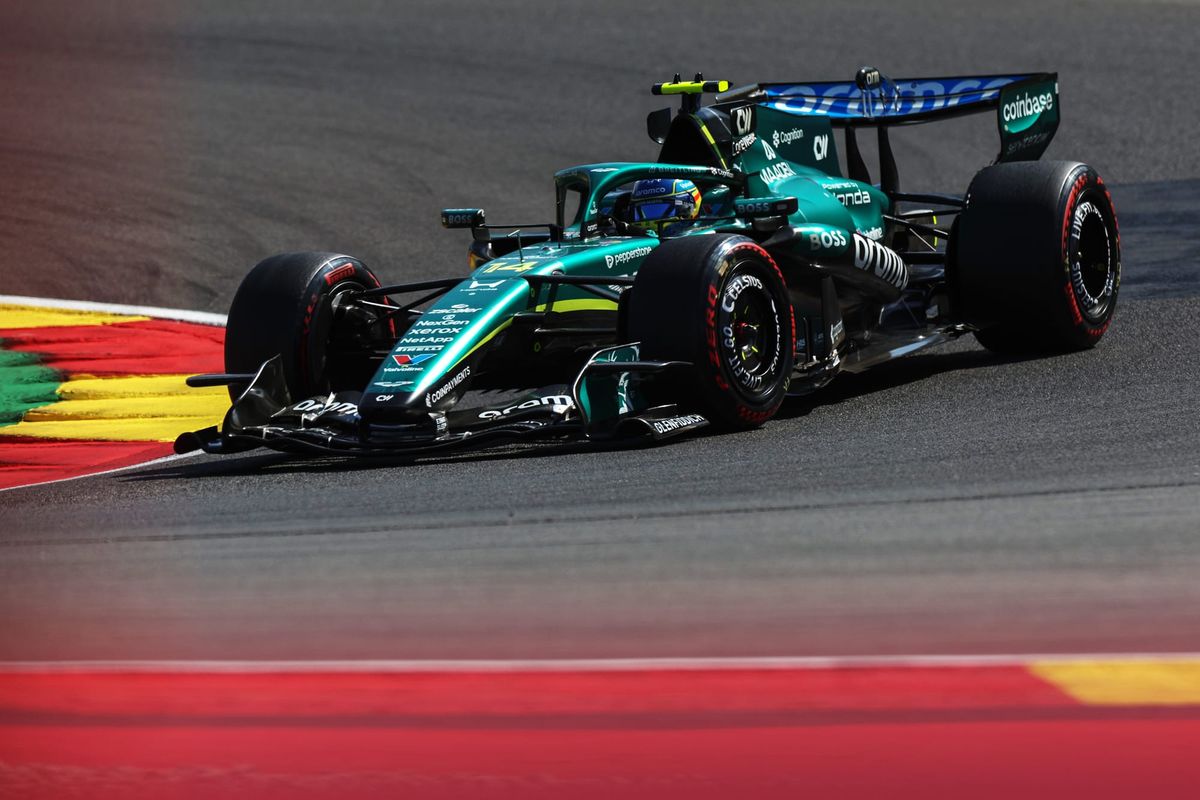
Aston Martin said a final farewell to this iteration of the worst Formula 1 car of 2026 with a typically awful performance at last weekend's Belgian Grand Prix.
Now comes the first major test of the Adrian Newey-led team that desperately needs to restore its battered reputation - and try to hang on to star driver Fernando Alonso.
We know Alonso has a big decision to make about his future in the coming weeks, having said he will consider his next steps during F1's August break.
But he insisted the debut of Aston Martin’s B-spec 2026 car - one the team refuses to call a B-spec but is in fact a B-spec because it will require a new, lighter, crash-tested chassis - will not be a major driver in that decision.
Alonso has been consistently clear that he dislikes this energy-starved version of F1, and revealed in Belgium that he has turned to driving old F1 cars from his personal museum as a way to maintain his love for the sport while current F1 disappoints him so greatly. (And in case you were wondering which cars they are: "I have old cars, 2007, 2012, my own Formula 1 cars that I drive from time to time and I do enjoy it a lot.")
The nuance in Alonso's position is that he doesn't enjoy driving 2026 F1 cars but he does still enjoy racing at the highest level. The clear implication here is that Aston Martin, so far cut adrift at the very back of the field, needs to haul itself into a place where it can at least fight with the midfield teams or else Alonso will probably consider this whole thing a lost cause.
He said he is trying to disassociate his decision from the team's underperformance, because he recognises Aston Martin began 2026 behind and feels this isn't a true representation of the team's potential.
After running around at the back all weekend at Spa, four seconds or more off the pace, and enduring one of the worst tracks of all for chronic energy starvation, Alonso is more concerned about whether he can stand much more of driving these underwhelming cars - even with staged modifications coming to the balance the split between electrical energy and combustion power for 2027 and 2028.
"My decision is not about the performance of this year," Alonso explained.
"This year we started [on] the wrong foot and I cannot base my decision for next year, on a performance that is not realistic. This is not the true potential of the team."
But even if the bias in the decision is more towards the rules and less about the competitive situation, that second part still has to be a significant factor for Alonso.
The Race understands internal targets are suggesting Aston Martin's upgrade to be worth in the region of several seconds' worth of laptime - maybe as much as two seconds. but this covers the entirety of the new aero package and car revisions - of which only the first phase is planned for Hungary this coming weekend - plus the single Honda engine upgrade that is due to arrive for the Dutch GP, the first race after the summer break.
Even if absolutely all of that best-case-scenario total pace had been available to Alonso at Spa, it wouldn't have transformed his weekend. He felt Aston Martin executed its qualifying session pretty well, not leaving obvious time on the table, and yet he exited Q1 in 21st place, 4.137 seconds off the pace and 2.031s behind the car directly ahead: the Cadillac of Sergio Perez.
So an extra two seconds of performance would have left him fractionally trailing the slowest of the two Cadillacs.
In the race, he finished two laps down - and more than 70 seconds behind the Cadillac of Valtteri Bottas.
This is why pre-weekend, Alonso was urging everyone to "remain calm" about the potential of the coming upgrades, because he clearly knows the underlying weakness of the Honda power unit - even if it's improved slightly - will still hold Aston Martin back on energy-starved circuits such as Monza.
And Alonso isn't getting carried away with whatever Aston Martin thinks it can deliver either, given how poor it's shown itself to be at car development outside of an impressive start to 2023. He also must be seriously concerned about Honda's capacity to improve, given his awful past experiences and the similarities between his current situation with the McLaren-Honda nightmare he endured a decade ago.
What Alonso wants to see this time is evidence the team has understood its problems and begun to fix them, what he calls "a gain in trust on what we are doing".
Alonso will undoubtedly feel he is still capable of competing at the highest level, and so even if the Aston Martin-Honda two-phase upgrade delivers everything that's promised, and Alonso is suddenly capable of fighting for the final spot in Q2 with straggling Williamses or Haases at certain tracks that aren't so power sensitive as Spa, so what? That's clearly beneath a driver of his standing and ability, and so he may decide he's done with it all regardless.
He's in a sticky spot here because alternative options in F1 are basically non-existent. The top four teams are all locked down for next season, with Max Verstappen's McLaren flirtations more about what happens the year after, so the best Alonso can realistically target is a sideways move to a midfield team such as Alpine - one he's already had three spells at.
But again, what's the point in that? It's not going to create a path back to the front of the grid. And having waited all his career to work with a car designed by Newey - who has a history of his concepts coming good eventually even if they start off in difficulty - why jack that in immediately unless it's for a guaranteed winning car?
That said, if Newey's first Aston Martin can't be fixed in fairly short order, Alonso - about to turn 45 the Wednesday after the Hungarian GP - might run out of time to see this project come good.
Stroll exposes aerodynamic problems
Should Alonso decide he's done with Aston Martin-Honda, and therefore F1 itself in all likelihood, whoever steps into that seat - perhaps an ambitious and resurgent Sergio Perez, or soon-to-be ex-Haas driver Esteban Ocon - will have to accept the fact that even a much-improved version of the car is going to be significantly off the pace.
At least until the team's pace of development starts exceeding those teams, such as Cadillac, Williams and Haas, who are further up the road.
Ocon's good friend Lance Stroll is locked in at Aston Martin basically in perpetuity because of the unique ownership structure at that team, but that doesn't mean he isn't just as frustrated with the current uncompetitive situation as his team-mate is.
Stroll said at Spa: "It's been pretty terrible - there's nothing we like about our car, there's no strengths, so we can only get better."
Asked about the viral onboards of him applying full lock at Silverstone, Stroll said he was deliberately provoking the car into that extreme state to show the team how badly it's performing.
F1's worst car for a decade
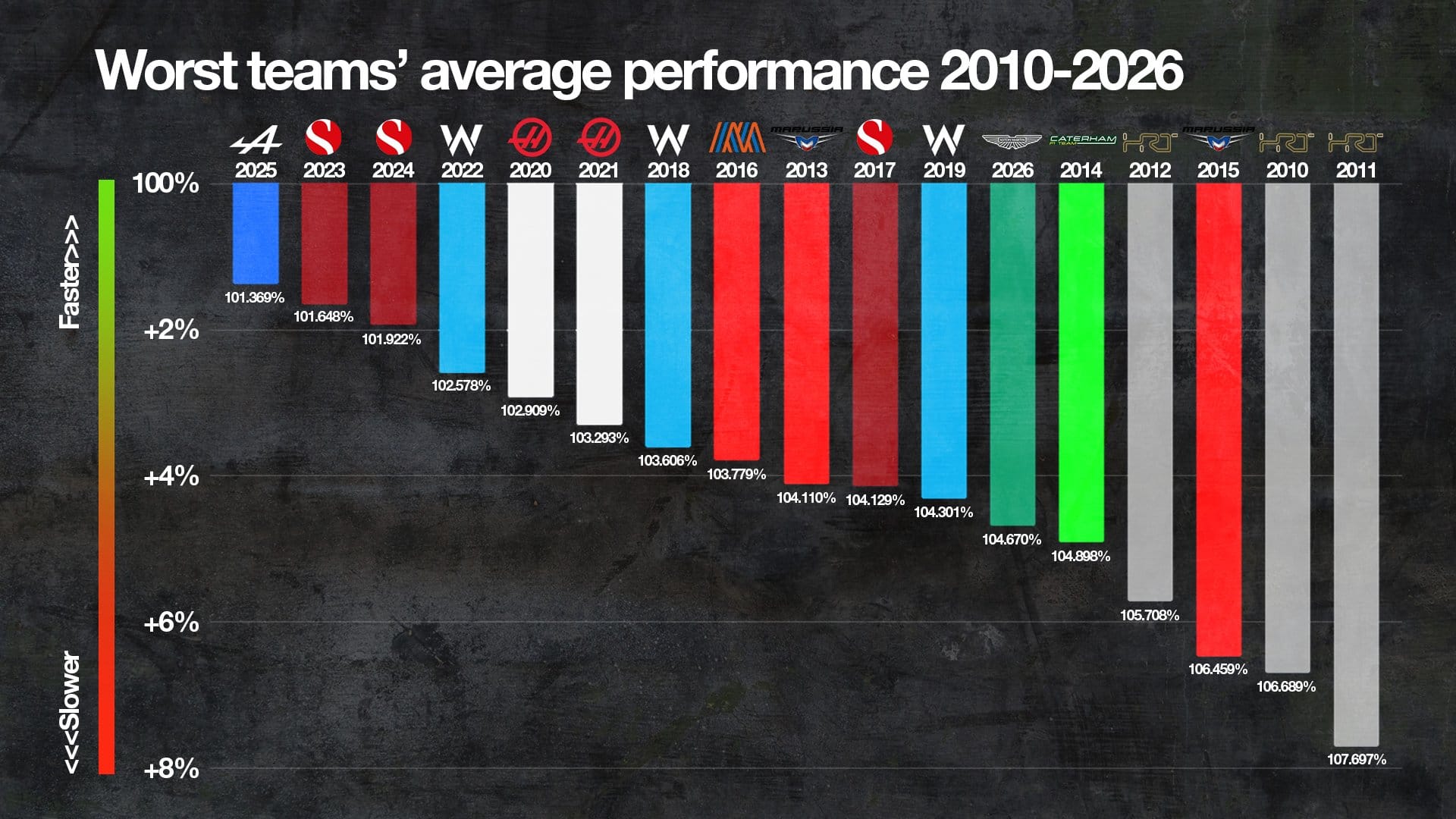
To put the woeful performance of the 2026 Aston Martin into context, it ranks comfortably among the absolute slowest F1 cars since 2010, when an influx of new - and perennially cash-strapped - teams joined the grid.
To be further off the pace, in relative terms, than the woeful 2019 Williams - which arrived to pre-season testing late and featured illegal front suspension - is a damning indictment of how poorly Aston Martin-Honda is performing so far in 2026.
As well as the high-speed aero stalls and understeer, Stroll lists medium- and low-speed corner entry instability and braking, poor driveability, lack of power, car balance issues, and an overall lack of downforce as weaknesses in this current package.
There's a lot of pressure on the single engine update Honda plans to introduce for Zandvoort. The Race understands Honda's battling detonation problems in the combustion chamber and struggling to achieve the lower maximum compression ratio permitted in the regulations.
Trying to find solutions in a cost-capped era is not something Honda is used to, and so that could further slow the rate at which it is able to chip away at its power deficit.
The Race asked Honda at Spa if it also needs to work on ancillary components of the power unit, such as the battery or the MGU-K, but trackside manager Shintaro Orihara indicated the internal combustion engine is his team's only focus right now.
Will the chassis upgrade be ready?
The twisty nature of the Hungaroring compared to Spa should reduce the car's sensitivity to the Honda power unit's lack of performance and better allow Aston Martin to judge whether it really has improved its car with these planned aero revisions, suspension changes and lighter components - if they're ready in time.
Last Thursday at Spa, Aston Martin's chief trackside officer Mike Krack said the team was working "flat-out to get the parts ready" for Hungary but whether everything would be in place was "the $1million question" because the schedules are "tight".
But he said after the Belgian GP that he'd been monitoring screens showing the upgraded car coming together in the race bays in the factory and now felt "quite confident that we have everything that we need".
Krack admitted some of the current-spec parts on Aston Martin's car are "very tired" now that it's prioritised this new specification, but said the team has been working hard to remain focused on extracting as much as it can from the current package in order to be ready for when the car does take a step forward.
Alonso indicated the team has finally found consistency over the past three races "in terms of deployment and things that are normal for everyone else", and Krack said the mood inside the team is "improving" now it can see "this tough time is coming to end".
But whether that tough time is really about to come to an end all depends on how powerful this much-anticipated upgrade really is.