What F1's new engine verdict has - and hasn't - told us
The FIA's announcement of its findings from the first two Additional Development and Upgrade Opportunities (ADUO) periods has served up answers and mystery in equal measure about Formula 1's engine ranking system.
On the one hand came the first official confirmation that Red Bull has started the 2026 rules era with the best internal combustion engine.
It was something that had never been formally ratified by the FIA before now, with the initial analysis having instead leaked over the Monaco GP weekend within minutes of the information being released to manufacturers.
The FIA said at that time that Red Bull was the only manufacturer not able to upgrade its power unit, with Mercedes allowed one development step and everyone else - Ferrari, Audi, and Honda - two.
But the FIA's announcement this week of no additional upgrade tokens being handed out after the second review period fell short of offering any new information about how things have changed since the first review and what the latest ranking is.
In a note tucked away in the middle of its release, the FIA stated: "Due to the confidential nature of this information, no further details on power unit performance index measurements will be communicated."
But in an F1 world where details matter, the ranking of power units is critical to performance.
So it was no surprise that the phones of manufacturers and teams lit up on Wednesday night as they tried to piece together a picture of where things stack up right now.
And although details were sparse about what the FIA's findings were, there is enough out there to give us a broad picture of the situation and what it means for the fight at the front of F1.
What we have (and have not) been told
Because of the sensitive nature of the FIA's analysis of the power units, it was agreed that whenever it released its ADUO rankings, the details it gave out would be light.
However, manufacturers did want knowledge of whether rivals would have opportunities to bring upgrades, so a procedure was agreed.
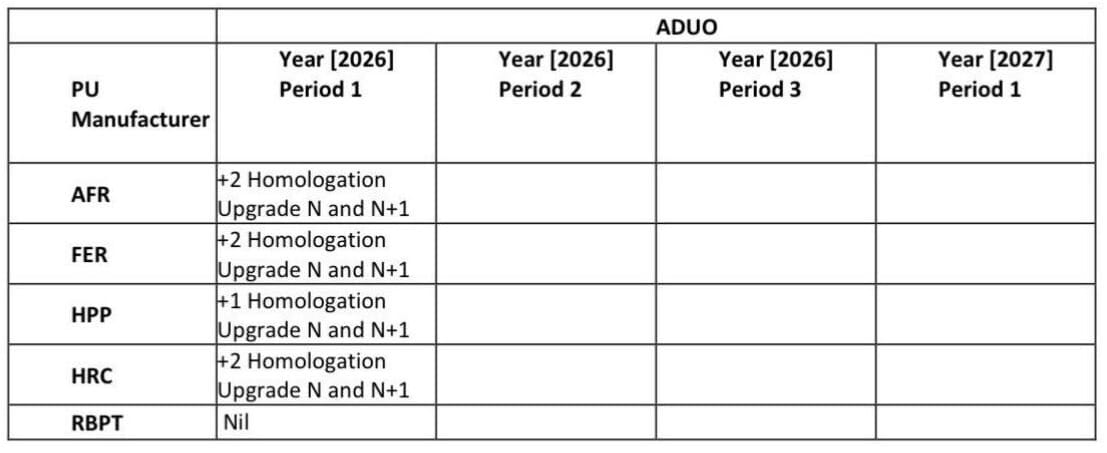
The FIA's policy is to release a document (the ADUO 1 version seen above) that states simply how many extra homologation opportunities each manufacturer will get.
Even though the information on offer is minimal, the first ranking - taken from the start of the season until round five in Canada - was enough to piece together a picture of where everyone stacked up.
That is because there are three grades of power units: the benchmark, any manufacturer 2-4% off that gets one upgrade, and those that are 4% or more off that get two.
So post-Monaco, we could work out that Red Bull had been judged the best, Mercedes was between 2-4% off, and everyone else was more than 4% off.
The FIA's ADUO 2 document shows that the homologation steps are unchanged, but there is no more information than that.
Manufacturers have been informed individually of where they stack up against the best and what allowances they get, but not where everyone else is ranked.
While this situation does not lay things out in black and white of how the engine ranking has evolved, it offers enough to piece together a broad outline of how things have developed.
For Red Bull not to have earned an homologation token, it means that it has to remain in the benchmark category.
That means any progress that Ferrari (which brought an ADUO upgrade to Austria) and Mercedes (reliability tweaks from Austria helped lift performance a little) made has meant neither is at least 2% ahead.
If one of them had leap-frogged Red Bull to leave it at least 2% adrift then Red Bull would have been granted ADUO and the right to a homologation token.
Shifting sands
While we know then there has not been a dramatic shift in the order since the first assessment, what we cannot be sure of from the FIA's announcement is whether there has been some more subtle movement.
The homologation tokens are not cumulative, so once you fall into a window that earns one then you do not earn any extra.
The limit is also capped at two, so only Red Bull or Mercedes dropping further from the front would have triggered a change of token allocations.
Lesser shifts cannot be confirmed from what the FIA has said.
For example, Mercedes not earning an extra token means it is in a window of anywhere between 1.99% in front of Red Bull to being 3.99% behind.
From Ferrari's perspective, its first engine step could in theory have also pushed it 1.99% ahead of Red Bull without it changing the homologations offerings - providing Mercedes had also kept itself within the 2% window.
According to the best guess of multiple sources, however, and based on what we have seen from new engine introductions, the most logical outcome from the second assessment period is that the original ranking has not changed much at all.
The Mercedes upgrade on reliability was more battery-related than on the internal combustion engine element that ADUO is based on, so its impact would have been negligible on the FIA's rankings.
Plus Ferrari's Austria upgrade, while a step forward, did not appear to be a game changer.
So it means the Red Bull is almost certainly still F1's best engine, with Mercedes and Ferrari behind.
Over the course of the ADUO 2 period (which ran from Monaco in early-June to Hungary in late-July), Audi and Honda also remained more than 4% adrift.
Things could change for the third ADUO period, which runs until the United States GP in late-October, if Ferrari's second engine upgrade, provisionally set for the Italian Grand Prix next weekend, is a good step forward. Honda's 'Spec 2' will also get judged this time out.
But unless there is a big movement at the top, it means Red Bull remains alone in not being allowed to upgrade until the winter, when changes in some areas are allowed for the start of 2027.
Red Bull trapped
Red Bull was clearly taken by surprise at the first ADUO rankings, as it was convinced from its data that it never showed itself to be consistently more than 2% ahead of Mercedes.
But despite its belief, and request for the FIA to go through its analysis again, the governing body has stood firm and on Wednesday declared its findings were "incredibly robust".
While not having an in-season upgrade opportunity is frustrating in itself, there is actually another aspect to the upgrades system that is even worse for Red Bull.
It is that while the upgrade opportunities are capped, so Mercedes will only get one this season and one next, extra allowances for spending and dyno hours are not restricted.
So for every period that Red Bull is deemed to be in front - and it will remain there until others make a big step with their internal combustion engines - then its opposition are gifted extra cost cap spending and test bench hours to improve their power units.
Mercedes, if it is 2-4% off in ADUO 1 and 2 as suspected, gets a $3million downward adjustment in its cost cap each time.
And if it does not bring an upgraded engine before the end of the season that moves it into the same band as Red Bull, then it will get another $3million for the third measuring period and so on.
This element of rivals continuing to gain from a system where nobody wants to be judged the 'best' has highlighted another element of ADUO that perhaps does not work as originally intended.
There has already been debate about whether the FIA's analysis should be based on more than just the internal combustion engine element, with some suggesting that ranking should be judged on championship position instead.
Now, however, the way that Red Bull's hands are tied with a benchmark engine but an overall power unit that is not viewed to be the best (that accolade goes to Mercedes) will likely further push it for a change of rules going forward.
This is something that the FIA is open to, with single-seater director Nikolas Tombazis stating on Wednesday that "naturally there are areas which we may evolve over time".
But making change requires support from a majority of manufacturers, and right now Red Bull's rivals are all in a good place to keep on getting extra money and test bench hours by staying where they are.