5 factors that will dictate Madrid's first F1 race
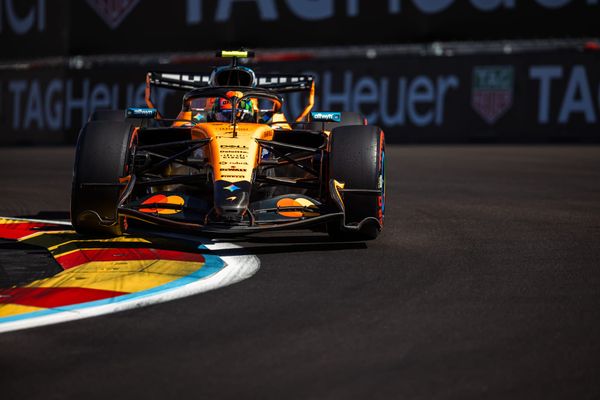
Formula 1’s teams and drivers head into the unknown in today’s Spanish Grand Prix as it’s the first time grand prix cars have raced at the new Madring. And that means there are some big questions about how the race will unfold, but with signposts to the potential answers.
Practice and qualifying have set some expectations, as has the way the Formula 2 and Formula 3 support races have played out, but the lack of racing history here to go on means that there could be some surprises.
Here are five key aspects that could shape the race.
Antonelli's possible start advantage
In the six Madring races held at the time of writing - three Formula 2 and three Formula 3 races - second on the grid has taken the lead at the start four times. And in Sunday’s F2 and F3 races, on both occasions the polesitter moved left quickly to cover the stronger start of the driver in second.
Pole position is on the left side as the TV viewer looks at it, which is as per convention as it gives the usual racing line for the corner, with second on the right.
You can be certain that McLaren's Lando Norris will be very well aware if there is any disadvantage to being on pole position, potentially meaning he will recognise the need to cover Antonelli. Then again, it might be that McLaren's generally good launches offset any disadvantage.
There is often a difference in grip on different sides of the grid, as well as the potential for it varying depending on each row, but this weekend the second-placed grid slot has got a little more grip than pole position. That could mean an opportunity for Antonelli at the start, and the need for Norris to consider covering him depending on how the launch goes.
Chicane chaos potential
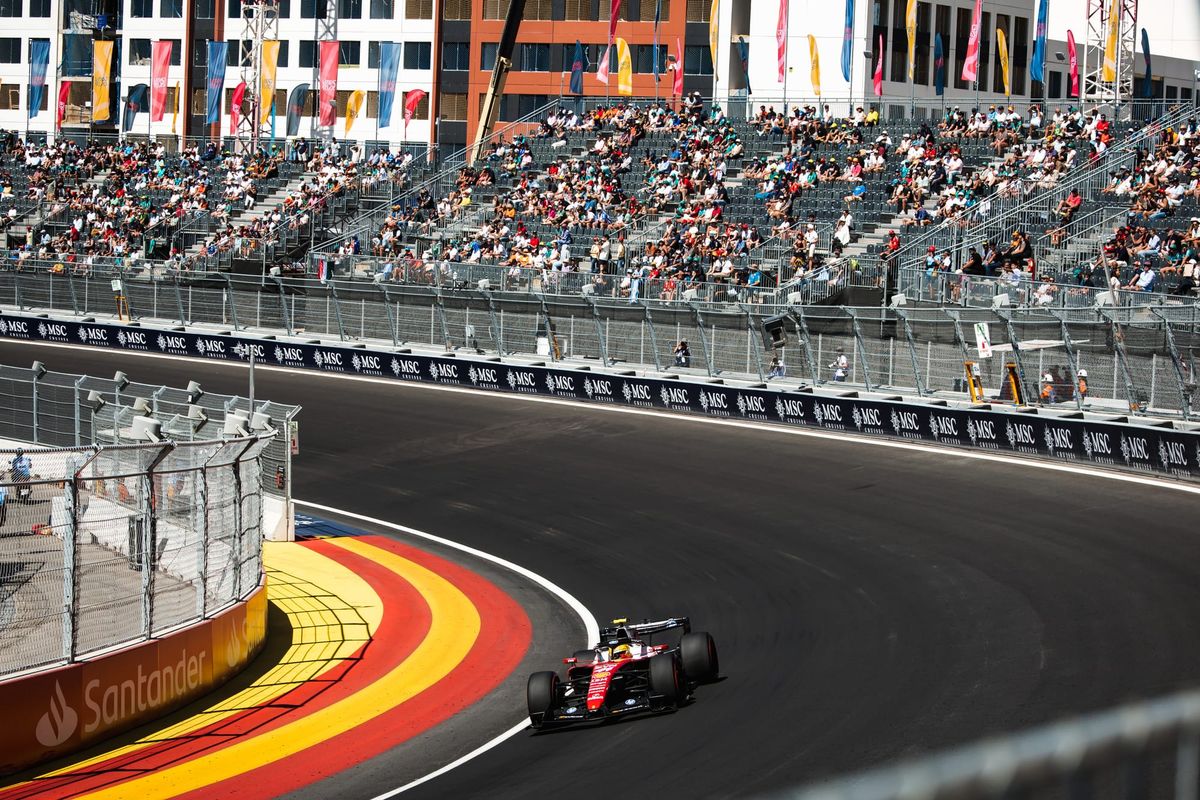
The main passing place at the Madring is the kerb-rattling Turn 5/5a/6 chicane that follows the long flat-out blast from Turn 2.
This has produced the most wheel-to-wheel action in the support races, but with the majority of instances resulting in one, or occasionally both, cars cutting the track. As George Russell put it, "the one small frustration in the design is the lack of clear overtaking opportunities", meaning the chicane is going to be the best chance anyone has.
"It's going to be very hard to overtake in the race in general," said Red Bull's Liam Lawson.
"It's very easy to defend there, or easier than normal corners, because you just push the guy off through the chicane and he has to give the place back."
This means there will be plenty of radio complaining, lots of frustrated attacks and the potential either for a collision or hitting the wall if you get it wrong in battle.
Or, as Alex Albon put it, "if you watched the F3 and F2 races, it was all drivers going side by side in the chicane and then complaining that one of them didn't let them back past."
The degradation challenge
Tyre degradation – both from front graining and rears overheating – has been one of the big talking points over the Spanish GP weekend.
The situation has improved a lot from Friday practice, when George Russell half-joked that the Madring race looked like it was heading for a six-stopper.
In fact, with the track having rubbered in quite well, things now look quite delicately poised time-wise between a one and a two-stopper.
So, with overtaking appearing to be difficult, that means the likely preference for teams will be to tell drivers to manage tyres and play the conservative route to minimise pit stops.
But that is all well and good for handling overheating tyres; stopping graining is a much harder task. Therefore, the level of graining will potentially be key.
As Audi’s Nico Hulkenberg said about whether the race would be chaotic or processional: “Look, it really depends, if we get graining, if we don't, I think that will be the main driver.
“If we get graining, I think it's going to be quite something and it might be chaotic. But, like you say, you know, you never know.”
Graining could trigger understeer, make the high-speed corners very difficult and trigger a rapid increase in degradation levels – throwing some strategy complications.
So all eyes need to be on those front-left tyres.
Will there be rolling roadblocks
Given the need to protect the tyres and potentially eke out a one-stopper, Antonelli suggested "it's going to be grandmother driving in the first 10 laps", while Max Verstappen says "you need to rely on people [tyre] deg-ing very aggressively".
So does that mean this could be one of those races where the leader either of the race overall, or of a pack of cars, can back off dramatically and easily hold up a queue of cars?
It's a track where defending is easy, and with last year's cars it would definitely be on the cards.
However, with the deployment factor, it's now possible to use a huge power advantage to make a drive-by move in an unlikely place, meaning that you are more vulnerable if you are committing to holding up rivals too much.
But, there are limited opportunities even to do that as there are full-throttle zones where it’s easy to keep a car behind - Carlos Sainz inadvertently impeding Valtteri Bottas on the run up the hill to Turn 7 illustrated that yesterday.
Driving mindset
A look back through the history of the Azerbaijan Grand Prix has shown that the characteristics of a race can often depend on the collective mindset of the drivers.
When chaos is predicted – as has happened many times in Baku – the drivers can change their approach. They opt to play it safe, sensing that staying out of everyone else’s trouble will guarantee points.
That tactic is all well and good. However, when everyone does it then the result can be a level of calmness that leads to a subdued race.
Cadillac driver Valtteri Bottas thinks it is possible that Madring does not deliver the unpredictability that its layout hints at – as happened when opening practice threw up zero stoppages.
“Like FP1, if people are too cautious, then that can happen,” he said.
“But you just never know. It's a track like that: one mistake and it will be yellow or safety car or red flag, so surely somebody is going to make a mistake.”
Despite the example of Baku bouncing between chaos and calm, Charles Leclerc thinks in the end Madrid will be somewhere in the middle.
“I wouldn't use those extreme ends, but surely I don't know about the chaos in a way,” he said.
“I think there may be some red flags or some incidents on a track that is so challenging like this one. However, Baku can be quite crazy with overtakes, while here, I struggle to see many, many overtakes.”